Vancouver law firm marketing should begin with three facts: the matters the firm wants, the places it can genuinely serve, and the way an inquiry becomes a consultation. A location page is useful only when those facts are clear. It should not imply an office that does not exist or promise a ranking that nobody controls.
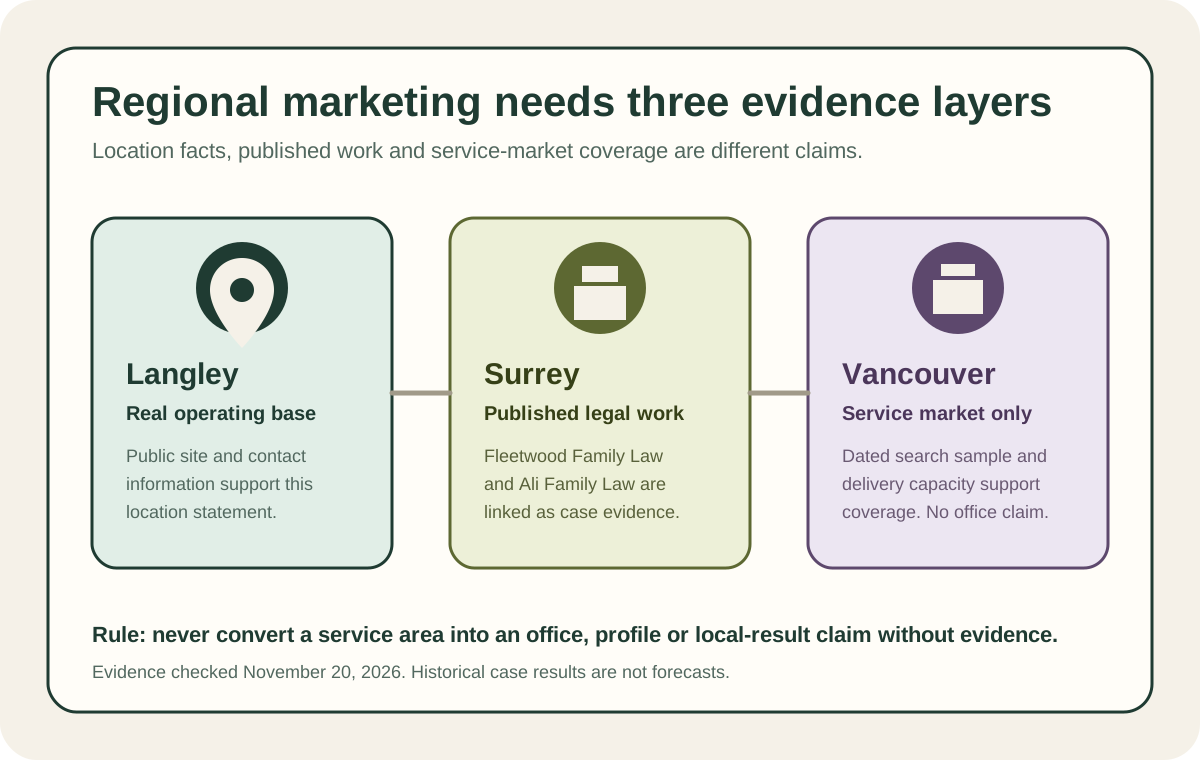
Small World Marketing is based in Langley, British Columbia. We serve law firms across Metro Vancouver and beyond, and our published local case work includes Surrey family law firms. We do not claim a Vancouver office. This page describes Vancouver as a service market and connects that market to our real Langley base, existing Surrey work, and public legal marketing services.
If your firm wants a practical review of its website, search visibility and intake path, request a law firm marketing audit. You can also start with our broader law firm marketing service or review our established Surrey law firm marketing page.
Start with the actual Vancouver service model
Metro Vancouver is not one interchangeable local market. Metro Vancouver's official member-jurisdiction list includes the City of Vancouver, City of Surrey, City of Burnaby, City of Richmond, City and Township of Langley, and other municipalities. That regional definition is useful for planning coverage, but it does not turn every municipality into an office location.
A firm should document where lawyers meet clients, where they can act, whether remote consultations are available, and which practice areas are accepted. The website can then distinguish an office page from a service-area page. Searchers should not have to infer whether an address is real or whether a firm can actually help with the matter described.
Small World Marketing uses the same distinction for itself. Our Langley base is genuine. Our Surrey legal work is documented in public case studies. Vancouver is a market we can serve without representing that we have an office there.
| Public statement | Evidence required before publication | How this page handles it |
|---|---|---|
| Office in a city | Real, staffed location and accurate public details | No Vancouver office is claimed |
| Service across Metro Vancouver | Actual delivery capacity and a clear service model | Vancouver is described as a service market |
| Local legal experience | Named, published work that can be inspected | Fleetwood Family Law and Ali Family Law are linked |
| Search performance | Dated measurement, source and limitations | The November 20, 2026 sample is published with limits |
| Legal or professional compliance | Review by the responsible firm and appropriate professional | Official rules are linked; no compliance guarantee is made |
Google's Business Profile representation guidelines say a business should represent itself as it is recognized in the real world. The guidance also says a virtual office is not eligible unless the stated conditions are met. A service-area setting does not create a new staffed location. The safest location strategy is the accurate one.
What the dated Vancouver search sample showed
On November 20, 2026, we ran a small, reproducible cloud search sample using four explicit queries:
- Vancouver law firm marketing agency
- law firm SEO Vancouver
- Vancouver law firm web design
- site:smallworld.ca Vancouver law firm marketing Surrey Fleetwood Family Law
The sample surfaced local agencies, specialist legal-marketing pages, lawyer SEO pages, and web-design pages. The results repeatedly separated three commercial needs: organic and local search work, website design, and intake or conversion support. Several pages used Vancouver or Lower Mainland location language, while others presented national legal-marketing services.
This is not a ranking report. The search was run from a cloud environment, not from a person's device in Vancouver. It did not reproduce Google Maps, a signed-in search, a mobile searcher, or every neighbourhood. We did not record an exact position because results can change with time, device, location and personalization. The sample shows the page types and claims that surfaced for these queries, not a guaranteed ordering.
The full observations and URLs are available in the downloadable Vancouver law firm marketing search sample. That file records the date, query, observed pages and the same limitations stated here.
| Query theme | What surfaced in the sample | Planning implication |
|---|---|---|
| Law firm marketing agency | Local and specialist agency pages | Explain the work, evidence and operating model plainly |
| Law firm SEO | Dedicated lawyer SEO and location pages | Connect practice priorities, service area and measurement |
| Law firm web design | Legal website specialists and local web studios | Explain ownership, accessibility, content and intake requirements |
| Small World and Vancouver context | The existing Surrey page and published legal work | Preserve Surrey while adding a distinct Vancouver service-market page |
The observation is intentionally modest. A search sample can help form questions, but it cannot prove what a specific law firm should publish. The next step is to compare the firm's own pages, Search Console data, Business Profiles, analytics, intake records and service capacity.
Build the location architecture around real entities
A regional law firm often needs a clear hierarchy:
- A main practice or service page explains the firm's offer.
- A real office page explains the lawyers, access, address, hours and consultation process for that location.
- A service-area page explains how the firm serves a distinct community when the coverage is genuine.
- Practice-area pages explain the matters the firm accepts.
- Guides answer documented questions and link back to the relevant service.
These pages should not compete by repeating the same paragraphs with a city name changed. A Vancouver page needs Vancouver-specific service facts or observations. A Surrey page should remain focused on Surrey. That is why this page supplements rather than replaces our Surrey law firm marketing resource.
For a firm with more than one office, each office page needs its own verifiable information. For a firm with one office and a wider service area, the website should say how service works outside the home city. Remote consultation, court attendance, languages, accessibility and appointment arrangements should be stated only when they are true and current.
Do not build a location page solely because a keyword tool lists search volume. First confirm that the firm can serve the matters and geography, then decide whether a distinct page will help a person understand the service.
Connect SEO to the practices the firm wants
The Vancouver plan should begin with matter priorities, not a generic promise to increase traffic. A family law firm, an employment boutique and a criminal defence practice have different questions, urgency, intake requirements and review needs.
Map each priority practice to one primary service page. Review what the page already earns, what information is missing, and which related questions deserve separate guides. Improve an established page before creating a second page that targets the same task.
Our local SEO guide for Canadian law firms explains how website pages, real business entities and local profiles connect. The Google Business Profile guide for Canadian law firms covers profile eligibility and record keeping in more detail.
| Planning layer | Evidence to review | Decision |
|---|---|---|
| Practice priority | Firm strategy, accepted matters and capacity | Which service deserves attention first |
| Existing page | Search Console queries, links, conversions and current copy | Improve, merge or create |
| Geography | Real offices, service arrangements and client access | Office page or service-area page |
| Local profile | Eligibility, ownership, categories and accurate details | Maintain, correct or leave unchanged |
| Inquiry path | Calls, forms, routing and consultation outcomes | Fix intake before adding traffic |
Search data should stay connected to a useful person-level task. A query may indicate an information need, a location need, or a readiness to contact a firm. The page should answer that task without overstating what the firm can do.
Design the website for a calm first decision
People arrive on a law firm website under different levels of pressure. The page should identify the practice, jurisdiction, lawyers, location and next step without forcing a visitor through vague promotional copy.
A useful website review checks:
- clear practice and location information
- readable text and keyboard navigation
- responsive layouts on small screens
- accurate lawyer biographies and credentials
- contact choices that match actual staffing
- form language that discourages confidential details before a lawyer-client relationship exists
- ownership of the domain, analytics, content and hosting accounts
- redirect and launch plans if the site is being rebuilt
Our law firm website design service covers those project decisions. A redesign is not automatically the answer. If the current platform supports careful editing, fast pages and reliable intake, focused changes may be better than a rebuild.
Visual design should reinforce the firm's real identity. Avoid invented awards, stock-client stories, unsupported superlatives and generic courthouse imagery presented as local proof. A photograph, credential, testimonial or result should have a documented owner and approval status before publication.
Treat intake as part of the marketing system
Visibility cannot produce a useful business result if contact fails. Test the phone number, tap-to-call link, form, scheduler, confirmation message and receiving inbox with fictional information. Confirm that the inquiry reaches the responsible person, then document how the firm categorizes the outcome.
Useful stages may include:
| Stage | Operational question | Evidence |
|---|---|---|
| Inquiry received | Did the call or form arrive? | Call log, form delivery or CRM event |
| Relevant matter | Does the request match accepted work? | Consistent intake category |
| Consultation arranged | Did the next step occur? | Appointment record |
| Retained client | Did the firm accept the engagement? | Aggregate firm reporting |
| Not suitable | Why was the inquiry not pursued? | Broad, non-confidential reason |
Keep confidential facts out of marketing reports. Aggregate categories are normally enough to evaluate the path from a page to an inquiry. Access to intake systems should follow the firm's privacy and security rules.
Paid search can support the same system, but media spend should be reported separately from agency work. Organic visibility, map visibility, ad clicks, calls and retained matters are different measurements. Do not combine them into a single success number without explaining the definition.
Use content that can survive professional review
The Law Society of British Columbia's Chapter 4 marketing rules state that lawyer marketing must not be false, inaccurate, unverifiable, reasonably capable of misleading the recipient, or contrary to the public interest. The commentary also addresses unjustified expectations.
That makes evidence and review part of production, not a final cosmetic step. Every firm-specific claim should have a source and an owner. Jurisdiction-specific legal information should go to the firm's designated lawyer or qualified reviewer before publication. Credentials, office details, service scope, fees and consultation arrangements need the same care.
Google's people-first content guidance asks whether content provides original information or analysis, demonstrates first-hand knowledge, and helps the intended audience achieve a goal. A queue of interchangeable city pages does not meet that standard simply because each page is long.
Small World Marketing's law firm content marketing service uses an inventory, source and review process. The firm remains responsible for approving its legal substance, professional claims and service information.
Read our local legal work in its published context
Small World Marketing's local evidence comes from named public work, not from an invented Vancouver case.
The Fleetwood Family Law case study reports historical work for a Surrey family law firm. The public study describes growth from zero to more than 600 monthly organic visits and referring domains from 9 to 280. Those are past results in that engagement, not a forecast for a Vancouver firm.
The Ali Family Law case study documents another Surrey family law engagement. Together, these studies support our statement that we have local legal-marketing experience. They do not establish an office, a current ranking in Vancouver, or a guarantee that another firm will obtain the same result.
| Claim on this page | Public evidence | Limit |
|---|---|---|
| Small World Marketing is based in Langley | Site contact and service-area information | No Vancouver office claimed |
| We have Surrey legal case work | Fleetwood and Ali Family Law case studies | Historical work, not a forecast |
| Vancouver results include specialist and local providers | Dated CSV search sample | Cloud sample, not geolocated ranking data |
| Metro Vancouver contains multiple member jurisdictions | Metro Vancouver official member list | Regional definition, not business presence |
| BC lawyer marketing has accuracy limits | Law Society of BC Chapter 4 | Firms need their own accountable review |
This publication's factual review checked the location statement, internal case-study links, dated search sample, official regional definition, Google profile guidance and Law Society rule text. The page contains no client testimonial, invented office, fabricated ranking or legal advice. A law firm using the framework still needs to approve its own facts and professional obligations.
A practical first 90 days
The first three months should produce inspectable work rather than a ranking promise.
Days 1 to 30: establish the baseline
Inventory the firm's services, accepted matters, offices, service areas, profiles, pages and intake routes. Export current search and analytics data. Test contact paths with fictional information. Record who owns each account and who approves legal content.
Run a dated Vancouver search sample for the firm's priority practices. Record the query, device or environment, date, notable page types and limits. Use it to form questions, not to claim that a single result set represents the market.
Days 31 to 60: improve the first path
Choose one priority practice and its strongest existing page. Improve the information, internal links, location clarity and contact path. Correct profile or directory facts only where the firm controls and can verify them.
If a distinct Vancouver service page is justified, write it from the firm's actual service model and local evidence. Preserve useful existing city pages and redirect only when consolidation is deliberate.
Days 61 to 90: publish and measure
Publish lawyer-reviewed supporting content for the questions that matter to prospective clients. Check indexing, internal links, page performance, calls and forms. Compare inquiry quality using stable definitions.
Record what changed, the date, the reviewer and the result. If evidence does not support a claim or page, hold it rather than filling the gap with generic copy.
Questions Vancouver law firms should ask an agency
Ask the agency to show how its recommendation connects to your accepted matters, real locations and intake. Request a list of accounts and assets the firm will own. Ask who drafts, who checks sources, and how lawyer review is recorded.
For regional work, ask:
- Which page is primary for each practice and city?
- How will existing Surrey, Burnaby, Richmond or other city pages be preserved?
- What proves an office or service-area statement?
- Which search observations were collected, when, and with what limitations?
- How will calls and forms be tested without using confidential information?
- Which outcomes are agency measurements and which require firm reporting?
- What happens to the content, website and data when the engagement ends?
The answer should be a deliverable and evidence trail, not a guaranteed position. Search visibility changes with competition, platform systems, implementation and time.
Plan the Vancouver page that the firm can support
Bring the firm's priority practices, real office details, service arrangements, existing pages and intake process. We will review the evidence, preserve useful assets and identify the first page or technical fix that deserves attention.
Request a Vancouver and Lower Mainland law firm marketing audit. Small World Marketing serves this market from our Langley base and reports the work in the context in which it was actually completed.