An SEO audit should finish with decisions a firm can act on. Separate indexing failures, weak practice pages, local profile problems, and broken intake before recommending more content or a larger marketing retainer.
The deliverable is a record of findings with affected URLs, dated evidence, responsible owners and a way to verify the fix. A crawler score or a long export of warnings can help an analyst investigate. Neither establishes that the firm is losing cases or that every warning deserves work.
This guide explains a practical audit sequence for a law firm's website and search presence. It is a method, not a completed audit of a particular firm. The examples are hypothetical. For ongoing delivery, see our law-firm marketing and SEO service and SEO proposal checklist.
Set the scope and preserve the evidence
Begin with the services the firm actually provides, the jurisdictions it serves, genuine office locations and the types of inquiries it wants. Identify the public website, any separate campaign sites, existing profiles and the people who control each account. Audit the real operating arrangement, not a competitor's page count.
Record the review date, source, URL, device and relevant reporting window. Separate facts from interpretations. 'The contact form returned an error on this device at this time' is an observation. 'This could interrupt inquiries' is an assessment. A revenue-loss figure requires additional evidence that the error alone does not supply.
Use the minimum account access needed. Initial inspection usually does not require permission to publish, alter DNS, change profile ownership or install tracking. Agree separately on implementation access and production testing. Do not exchange passwords in an audit spreadsheet.
| Audit area | Evidence to collect | Limit to state |
|---|---|---|
| Intake and measurement | Authorized synthetic test, receipt/routing result and event record | A successful event is not proof staff received or answered the inquiry |
| Crawling and indexing | HTTP response, rendered page, robots controls and Search Console inspection | A current fetch and Google's indexed version can differ |
| Page coverage | URL inventory mapped to actual services, jurisdictions and reader tasks | More pages do not automatically mean better coverage |
| Local presence | Genuine office details, public profiles, access and dated observations | A search from one place is not a market-wide rank measurement |
| External references | Relevant public mentions, directory facts and link destinations | A tool's authority score is not Google's own score |
| Priorities | Finding, affected assets, confidence, dependency, owner and acceptance test | Priority is an editorial decision, not a measured revenue forecast |
Download the blank audit findings worksheet. It has no client data, generated scores or prefilled findings. Store private evidence separately under the firm's access controls and reference it without exposing personal information.
Validate tracking and intake before interpreting traffic
Start with the route a prospective client would use. Open the intended service page on phone and desktop. Check that the displayed phone number, contact link and next step are understandable and usable. With permission, test the form using clearly marked fictional information, then confirm delivery, routing and staff visibility. Avoid including real client matters in test submissions or screenshots.
Check the confirmation screen and what happens behind it. A form may show success while its notification fails. A call link may dial a different number from the one printed on the page. A scheduler may work but accept the wrong appointment type. These are distinct findings with different owners.
Then reconcile measurement. A button click, form submission, received inquiry, qualified inquiry and retained client are separate events. Write down which one each report counts. Confirm the reporting window and whether test traffic, spam and repeat contacts are excluded where appropriate.
For GA4 implementations, Google's DebugView documentation describes inspecting events from devices with debug mode enabled. Use that view to investigate instrumentation, then separately confirm the operational receipt. Seeing an event in a debugging tool does not show that the firm's intake team handled it.
If the audit lacks account access or permission for a production submission, say so. Public checks can establish that a contact route is visible and usable up to a point. They cannot establish inbox delivery, CRM routing or attribution accuracy. Record that limitation and assign an authorized test rather than inventing a pass.
Follow the diagnostic path rather than the tool score
The following tree keeps operational checks ahead of broad recommendations. Each branch identifies the next investigation, not the cause of every possible visibility problem.
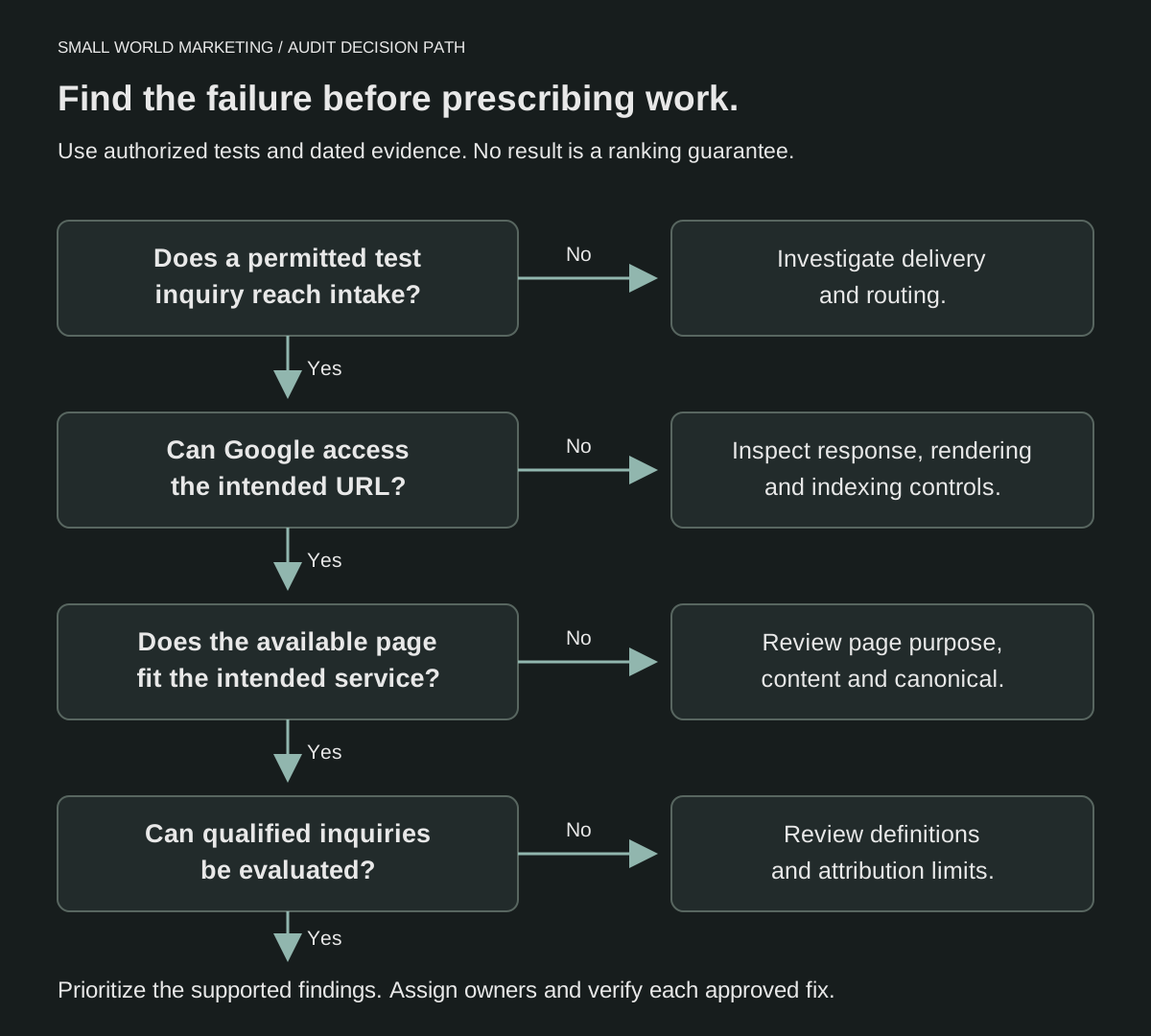
- If a permitted test does not reach intake, investigate delivery and routing.
- If Google cannot access the intended URL, investigate the response, rendering and indexing controls.
- If the available or indexed page does not match the intended service, investigate page ownership, canonical selection and content.
- If inquiry quality cannot be evaluated, investigate definitions and attribution before drawing a performance conclusion.
Passing a check narrows the investigation. It does not prove that a page ranks well, that every user can submit an inquiry, or that the program produces profitable clients.
Check indexing and which page owns each topic
Build a short list of priority URLs before crawling the entire site. Include the main practice pages, genuine office pages, lawyer information, contact routes and important supporting guides. Compare the list with navigation, contextual links, the sitemap and observed search landing pages.
For each priority URL, inspect the response and rendered content. Note redirects, errors, accidental access restrictions, missing text and conflicting indexing instructions. An intended public service page returning an error needs a different response from an intentionally excluded campaign page. Do not remove every exclusion simply because a crawler flags it.
Google's URL Inspection documentation distinguishes its stored indexing information from the live test. Record both when available, including the inspected URL and date. A positive live test is not a guarantee of indexing or search appearance. Without Search Console access, label an HTTP and HTML check as a public technical observation, not a confirmed Google indexing verdict.
Inspect canonical signals and redirects alongside the content. Google's canonicalization guidance describes ways to signal a preferred version; those signals should be consistent. Do not use a canonical as a general remedy for unrelated pages with different purposes.
Where two URLs appear to serve the same reader task, compare their content, links and query evidence before deciding to consolidate. Similar titles alone do not prove harmful competition. If a move is justified, plan redirects, internal-link updates and live verification. Preserve a useful existing destination rather than creating a second version by default.
Read performance without turning averages into a diagnosis
With authorized Search Console access, review the Search results performance report by relevant pages and queries, using stated date ranges. Compare like periods and record any changes in filters. Distinguish the firm's name from service searches where the available query data permits it. A total that combines both can hide a service-page problem.
Read clicks, impressions, click-through rate and average position together. A site-wide average does not establish the position of one service page for one query. A click decline may need investigation into demand, visibility, search presentation or measurement; the total alone does not identify the cause. Relate the observations to landing pages and qualified inquiries without presenting them as a complete attribution trail.
If only a short period or limited data is available, retain that limit in the finding. Do not replace missing account evidence with invented traffic or ranking estimates.
Review practice and location coverage
A useful practice page should make the service understandable: matters accepted, relevant geography, who provides the service, the process at an appropriate level and the next contact step. Ask the firm's reviewer to confirm the legal and service statements. An agency's SEO assessment is not legal approval.
Map each actual service to a primary destination and related supporting material. Look for missing answers that affect a prospective client's decision, not only missing keywords. A useful biography, clear service boundary or working contact route may address a more immediate problem than another generic blog post.
Review city and office content against real operations. A service area is not automatically a physical office. Record distinct local evidence and coverage before recommending a new city page. Existing local SEO guidance explains that office, profile and service-page relationship.
Check readability and use on phone as well as desktop. Can the reader find the relevant service and lawyer? Do expandable sections work with a keyboard? Are table columns accessible without forcing the whole page sideways? Do diagrams have a useful text equivalent? Record observed barriers rather than declaring compliance from a single automated score.
Inspect local profiles and external evidence
Inventory the profiles the firm already has before proposing new ones. Compare public name, contact details, address or service-area arrangement, website destination and categories with the actual business. Record access problems and possible duplicates for review. Do not create another profile merely to fill an audit checklist.
Google describes local results in terms of relevance, distance and prominence. That makes location and search context important when recording an observation. Save the query, date and location assumptions; one screenshot is not a reliable report of visibility across an entire city.
Check eligibility and profile structure against Google's business representation guidelines, particularly when a firm and individual practitioners have separate records. Recommend changes only after confirming the facts and who is authorized to manage the profile. Our law-firm Business Profile guide provides a focused review framework.
For external references, inspect actual pages and destinations. A professional directory with outdated contact details presents a factual correction task. A relevant public mention that points to a retired URL presents a link and redirect investigation. Neither finding requires claiming that a third-party score measures Google's trust.
Treat review responses and client-related material carefully. Identify the operating issue, assign the firm's review owner and avoid publishing confidential details in an audit report. Do not infer misconduct, fabricated reviews or a search penalty from a suspicious-looking pattern alone.
Turn findings into a decision matrix
Each row should be specific enough that someone else can reproduce the check and recognize completion. Avoid rows such as 'improve SEO' or 'increase authority.' They do not establish what will change.
The following rows are hypothetical examples, not findings about SWM or any client. The sample paths are labels, not links to audited pages.
| Example finding | Affected asset | Evidence to record | Owner and next action | Completion check |
|---|---|---|---|---|
| A permitted form test does not reach the assigned queue | Contact form and routing rule | Test ID, device, time and receipt search | Intake administrator and developer investigate delivery | Repeat synthetic test reaches the correct queue; record the result |
| Intended service page is excluded from indexing | Example practice-page URL | Current response, directives and inspection result | Developer confirms intent with the site owner and corrects the exclusion if accidental | Public controls and live inspection reflect the intended state; later indexing is checked separately |
| Two pages appear to answer the same service question | Two example service URLs | Page comparison, internal links and available query data | Strategist and firm reviewer choose distinct purposes or a consolidation plan | Approved content and any redirects work; links and sitemap use the intended destination |
| Profile directs people to an obsolete page | Existing public profile | Dated profile screenshot and destination response | Authorized profile manager confirms the correct landing page | Public link opens the intended live page |
Preserve the original evidence after implementation. Overwriting it with a successful after-check makes it harder to understand what changed. Keep before and after records linked to the same finding and note any conditions that differ.
Prioritize by consequence, confidence and dependency
Priority is an editorial assessment. It is not a claim that a fix will generate a stated number of clients. Use the firm's actual goals and observed failure to explain the order.
| Decision band | When it may apply | What to do next |
|---|---|---|
| Investigate promptly | A reproducible failure blocks an important contact route or intended public page | Assign an owner, confirm scope and agree on a controlled fix |
| Schedule the improvement | The page works, but a documented relevance or usability gap affects a priority service | Define the copy, design or implementation task and acceptance test |
| Gather evidence | The concern depends on missing access, a small sample or conflicting observations | State exactly which data or permission is needed; avoid presenting suspicion as fact |
| Leave intentionally unchanged | The current arrangement serves a documented purpose and the warning is not a defect | Record the reason and a condition that would trigger another review |
Consider dependencies and reversibility. A service-page rewrite may wait on the lawyer's review. A URL change may need redirect testing before release. A measurement problem may need attention before anyone can fairly compare outcomes. Estimated effort should be identified as an estimate, with an owner who can confirm it.
Budget recommendations should follow the agreed tasks. Our law-firm SEO cost guide separates recurring work, review, implementation and one-time projects. An audit does not automatically justify a larger retainer or a complete website rebuild.
Close the audit with verification and limits
Deliver a concise decision summary, the findings register and the evidence references. Explain what was checked, what was not checked, which changes are approved and which still need access or review. Use clear states such as observed, investigating, approved, implemented and verified. 'Implemented' should not silently mean 'live and checked.'
After a change, inspect the actual public destination and the relevant operating result. Retest redirects and contact routes when they changed. Recheck canonical, indexing controls, links and sitemap entries for page moves. Keep later search observations separate from immediate implementation checks; a working release does not establish a ranking improvement.
For AI search and GEO, distinguish technical readiness from observed mentions, citations, visits and inquiries. An audit that reads website markup cannot truthfully report that ChatGPT recommends a firm without separately observing and documenting that result. Our AI visibility guide covers those separate measurements.
Bring the website, priority services and available account owners to an audit discussion. The useful outcome is an agreed next action with evidence and responsibility, not a score that creates more questions than it resolves.
Sources and method notes
Primary documentation checked October 19, 2026:
- Google Search Console: URL Inspection.
- Google Search Console: Search results performance report.
- Google Search Central: canonicalization.
- Google Business Profile: local ranking.
- Google Business Profile: representation guidelines.
- Google Analytics: DebugView.
The workflow, priority bands and example findings are SWM's editorial framework. No proprietary client analytics, completed audit findings, revenue-loss estimates or new performance results are asserted. Search platform documentation and product interfaces can change; retain the source and review date with each real audit.