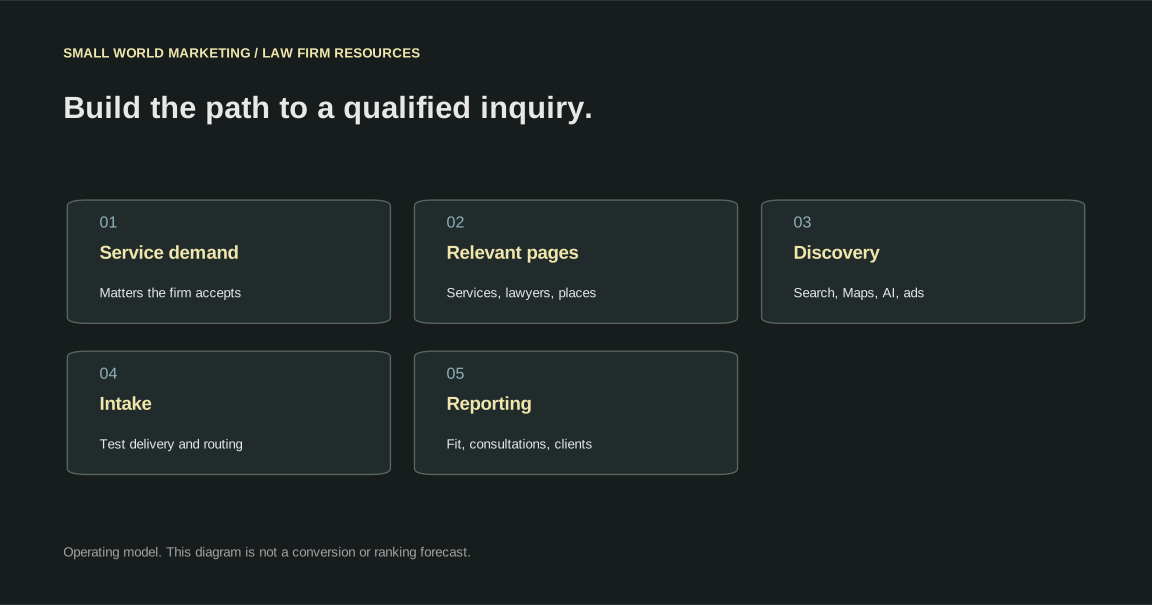
Law firm marketing works when the right person finds the right service, understands why the firm fits, and reaches an intake team that can help. Rankings support that process. The business outcome is a qualified inquiry and, where appropriate, a retained client.
Small World Marketing helps law firms across Canada and the United States with SEO, local search, website design, paid search, and AI search visibility. We are based in Langley, British Columbia. Our legal work includes family, personal injury, employment, immigration, criminal defence, and trademark practices.
Start with the matters your firm wants more of, the places it can serve, and its capacity to respond. That produces a more useful plan than a list of keywords disconnected from the lawyers and intake staff doing the work.
Request a free law firm marketing audit or see our published legal case studies.
Decide which inquiries the marketing should produce
Define the target matter before choosing a channel. A family practice seeking contested divorce matters has a different content and intake problem from an employment firm serving employees with termination disputes. The distinction affects the landing page, geographic coverage, advertising language, and questions asked at first contact.
Document services the firm accepts and services it does not. Identify the relevant jurisdiction, languages actually supported, office arrangements, and consultation process. Make those facts visible where they help someone decide whether to contact the firm.
| Planning question | Decision it supports | Evidence to bring |
|---|---|---|
| Which matters should grow? | Primary service pages and search themes | Firm priorities and intake feedback |
| Where can the lawyers serve clients? | Local pages, profiles, and campaign coverage | Actual offices and service arrangements |
| What makes an inquiry relevant? | Form categories and reporting definitions | Broad qualification criteria approved by the firm |
| Who handles first contact? | Routing and response workflow | Intake ownership and actual availability |
| Which pages already work? | Improve existing assets before rebuilding | Search Console, analytics, and inquiry records |
Keep confidential matter details inside the firm's approved intake systems. Marketing reports usually need aggregate outcomes and broad categories, rather than copies of a client's narrative.
Build a page structure that matches the practice
A strong legal website gives each substantial service a clear destination. The page explains what the firm handles, where the information applies, which lawyers provide the service, and how to begin contact. Supporting guides answer related questions and link back to that service.
Use one primary page for a searcher's task. Avoid creating several versions of the same divorce service page because the title can accommodate another keyword. A distinct page earns its place by covering a distinct service, location, audience, or question.
Our existing practice resources cover family law marketing, personal injury lawyer marketing, employment lawyer marketing, immigration law firm marketing, criminal defence marketing, and trademark attorney marketing. The strategy changes with the firm's services and market.
Website work should also account for editing, mobile use, accessibility, account control, and the transition from the current site. Our law firm website design service explains the project requirements in detail.
Treat local search as an operating asset
Local SEO connects the firm's real-world presence with its public information. It involves eligible Google Business Profiles, relevant website pages, consistent directory records, and an appropriate review process.
Google describes local ranking in terms of relevance, distance, and prominence. A business cannot buy a better organic local ranking from Google. Accurate information and useful pages support the work; an agency cannot move a searcher closer to an office. Google's local ranking guidance.
Start with the actual office and practitioner structure. A service-market page does not establish that a firm has a physical office there. Nor does every lawyer automatically qualify for a separate profile.
Read our local SEO guide for Canadian law firms and Google Business Profile guide for the page, location, and profile decisions.
Give content a useful job
The next article should solve a documented question. Intake staff can identify recurring uncertainties, while page and query data show how people already find the firm. Combine that information with lawyer review and primary sources.
For example, a prospective client may need to understand the firm's consultation process before discussing a matter. A clear process page can reduce uncertainty without attempting to answer a fact-specific legal question. A substantive legal guide needs the appropriate jurisdiction, reviewer, sources, and review date.
We draft content around those requirements. The firm approves legal substance, credentials, service boundaries, and claims. Our law firm content marketing service explains the inventory, review, publishing, and refresh process.
Connect SEO, paid search, and AI visibility without mixing the measurements
Organic search, Google Maps, paid ads, and AI answers are different discovery surfaces. They can support the same intake process, but their costs and measurements need separate reporting.
| Surface | Work to assess | Useful outcome |
|---|---|---|
| Organic search | Service coverage, indexing, content, internal links, relevant authority | Relevant visits and qualified inquiries |
| Google Maps | Profile eligibility, accuracy, categories, local page connections | Relevant calls, visits, and inquiries |
| Paid search | Query targeting, campaign settings, landing page, conversion checks | Qualified inquiries relative to media and management costs |
| AI answers | Public accuracy, useful sources, observed mentions and citations | Verifiable appearances, referral visits, and attributed inquiries |
Google's guidance for AI Overviews and AI Mode says established SEO practices remain relevant. There is no special AI schema or text file required for inclusion. That does not guarantee that an eligible page will appear. Google's AI search guidance.
We distinguish a technical website check from an observed AI citation. Our AI visibility guide for law firms shows how to record the difference.
Make the inquiry path work before scaling traffic
Test the service page, phone link, form, scheduler, and notification route with fictional information. Verify the receiving inbox or CRM, then check the confirmation shown to the visitor. A successful animation on the website does not prove the inquiry arrived.
Agree on the reporting stages: inquiry received, relevant matter, consultation booked, and retained client where the firm can report that responsibly. Record duplicates and spam separately. A rise in form submissions means little if the intake team cannot identify which were useful.
If a redesign or hosting change is involved, preserve the working addresses and integrations. Our hosting guide and website migration checklist cover those dependencies.
Judge the proposal by the work and evidence
An SEO engagement should specify the initial audit, planned pages, technical implementation, profile work, content review, reporting, and access arrangements. Each deliverable needs an owner and a way to verify completion.
| Stage | Work | What the firm can inspect |
|---|---|---|
| Baseline | Review pages, search data, profiles, and intake | Findings tied to affected URLs and accounts |
| Priorities | Match service demand to existing assets and gaps | A page plan with reasons for each action |
| Implementation | Publish approved content and complete technical/profile work | Live changes and validation evidence |
| Measurement | Review visibility and inquiry outcomes | Consistent definitions and documented attribution limits |
| Improvement | Refine pages and campaigns using new evidence | Next actions connected to findings |
This is a delivery sequence, not a promise that a competitive search will reach a specific position by a particular month. Ask how any commercial performance commitment is defined in the agreement. Use our SEO proposal checklist to compare scopes and our Canadian law firm marketing cost guide to compare the full budget.
Read the case work in its actual context
Our public portfolio includes the following legal work. The figures below are historical outcomes reported in the linked studies, not new measurements or forecasts.
| Published study | Reported outcome | Context |
|---|---|---|
| Fleetwood Family Law | From zero to more than 600 monthly organic visits; referring domains from 9 to 280 | Family law |
| Indie Law | Domain Rating from 27 to 47; 73 keywords in Google's top three | Trademark law |
| The Lacy Employment Law Firm | Domain Rating from 1.5 to 33; more than 6,000 monthly organic visits at peak | Employment law |
| The Clark Law Office | More than 140 keywords in Google's top three | Personal injury |
Use a case study to assess relevant experience and the explanation of the work. Historical traffic or ranking results are not a forecast for another firm. Market competition, starting assets, service scope, and implementation capacity affect the plan.
We also have a Surrey law firm marketing resource connected to our local legal work. Existing US market resources cover Chicago, Atlanta, Pittsburgh, and Des Moines. Each page keeps its own market and evidence context.
Common questions about law firm marketing
How much should a firm budget?
Start with scope and current assets. Separate agency fees, advertising media, website work, content, and recurring software. Our current pricing provides starting plans; a written proposal establishes the firm's actual arrangement.
Does the firm need a new website?
An existing site may need focused improvements rather than replacement. Review service-page coverage, editing limitations, technical problems, mobile tasks, and intake before deciding. A rebuild should address documented constraints.
Who approves legal content?
The firm should appoint an appropriate reviewer for jurisdiction-specific information, professional claims, and service descriptions. Marketing staff can organize research and draft pages; publication needs the firm's approval process.
How should success be reported?
Track relevant visibility, visits, inquiries, consultations, and retained matters where the firm can supply aggregate outcomes. Keep the definitions stable enough to compare periods and explain gaps in attribution.
Start with the firm you want to build
Bring your website, priority practice areas, genuine service locations, and current intake process. We will look at the existing assets, identify the gaps, and outline the work that fits the firm's goals.
Get a free law firm marketing audit from Small World Marketing.