The right agency conversation starts with the firm's desired matters and ends with a defined scope. Compare evidence, account ownership, intake measurement and the people responsible for delivery before signing.
Small World Marketing publishes this guide and sells marketing, website and hosting services to law firms. That is a commercial interest. This is not an independent ranking of Canadian agencies, and it does not name or score competitors. A useful shortlist depends on the firm's goals, market, internal capacity and evidence gathered directly from each provider.
The selection process should make claims testable. A polished proposal can describe strategy without showing who will do the work, what the firm will own, how an inquiry will be measured or what happens when the agreement ends. Put those questions into the evaluation before a sales call changes the criteria.
Define the matters, markets and operating limits first
Start with the work the firm is prepared to accept. "More leads" is too broad. A family firm may want complex property matters in two service areas but have limited consultation capacity. A business firm may want a smaller number of qualified files from a narrow industry. Those are different assignments.
Record the current intake path. Identify who answers calls, who reviews web inquiries, when conflicts are checked, how consultations are scheduled and where referral sources are stored. Marketing can increase demand, but it cannot repair an unmonitored inbox or create lawyer capacity.
Separate the firm's objective from the agency's proposed channel. The objective might be more qualified employment-law consultations. SEO, paid search, local visibility, content, referral support and website changes are possible ways to support that outcome. A provider should explain why a channel fits the task and what must be true for it to work.
The law firm marketing service page explains SWM's commercial scope. The law firm SEO services guide provides a more detailed deliverable checklist for search proposals.
| Selection input | What the firm should define | Evidence to bring into the process | Failure if it stays vague |
|---|---|---|---|
| Desired matters | Practice, matter characteristics and exclusions | Intake categories and responsible lawyer review | Reports count inquiries the firm would not accept |
| Service market | Where the firm can genuinely serve clients | Office, licensing and service-capacity facts approved by the firm | Pages or campaigns imply unsupported coverage |
| Intake capacity | Consultation slots, response owner and follow-up process | Labelled test inquiries and current operating hours | Demand reaches an unattended channel |
| Current assets | Website, profiles, ad accounts, analytics, content and case evidence | Account and content inventory | A proposal replaces useful assets without a reason |
| Approval roles | Who approves legal copy, claims, creative and budget | Named firm owners and expected turnaround | Work waits indefinitely or launches without review |
| Measurement | Qualified inquiry, consultation and retained-matter definitions | Current fields and reporting limits | Traffic or form counts are presented as business results |
| Risk limits | Privacy, conflicts, brand, accessibility and security requirements | Firm-approved policies and qualified review | Marketing staff make decisions outside their role |
Do not invent a target cost per matter to fill a planning spreadsheet. Use real firm economics and an approved method when those figures are available. Otherwise, compare observable inputs and label the missing data.
Build the shortlist without publishing a disguised ranking
A list of agency names is not useful by itself. The firm needs a repeatable way to decide which providers deserve a conversation.
Start with the services the project actually needs. Confirm them from the provider's current website, written scope or product documentation. Check the date. A page saying "full service" does not establish that the proposed team can handle a technical migration, paid-media tracking or lawyer-reviewed content.
Review public work relevant to the assignment. A law firm case example can help, but relevance matters more than the logo. Look for the starting condition, work performed, period measured, source, limitations and the provider's actual role. A percentage without a baseline or timeframe is not enough evidence.
Ask for a live explanation of one comparable project with confidential details removed. The provider should be able to distinguish its own work from demand, seasonality, firm reputation, media spend, offline referrals and other changes. Client confidentiality can limit disclosure. That is a reason to accept another form of evidence, not a reason to accept an unsupported claim.
References are most useful when the questions match the project:
- Who completed the work after the sale?
- Did the firm retain control of its accounts and assets?
- How were legal and factual approvals handled?
- What happened when intake or tracking failed?
- Were exclusions and additional fees clear?
- Could the client leave with usable content, data and documentation?
Create the scoring rule before the final proposals arrive. Otherwise, the team can unconsciously change the weights to favour the most persuasive presentation.
Compare channel scope line by line
Marketing proposals often bundle several disciplines under one monthly fee. Break the package into work that can be owned, delivered and accepted.
For search work, separate technical fixes, page strategy, content, local profile work, link or citation activity, measurement and reporting. For paid media, separate campaign structure, creative, landing pages, conversion setup, media spend and management fees. For web work, separate design, development, migration, hosting, maintenance and intake testing.
Content needs a visible review path. The provider can research, draft, edit and publish, but the responsible firm reviewer must approve legal accuracy, professional claims and jurisdiction-specific statements. An agency should not imply that keyword research substitutes for lawyer review.
| Workstream | Deliverable to request | Evidence before approval | Firm dependency | Common exclusion to surface |
|---|---|---|---|---|
| SEO planning | Page and query map tied to distinct client tasks | Current site and Search Console review where access is approved | Practice priorities and existing-page decisions | Copywriting, development or local profile work |
| Technical SEO | Named findings, affected URLs and acceptance checks | Crawl, rendered-page or platform evidence | Technical access and change approval | Developer implementation |
| Content | Brief, sources, draft, review status and final destination | Primary sources and firm-supplied facts | Lawyer or subject reviewer | Interviews, graphics, updates or publication |
| Local visibility | Profile, landing-page and citation responsibilities | Current profile ownership and real office facts | Accurate business representation | Review responses, listings cleanup or new profiles |
| Paid search | Campaigns, keywords, negatives, ads, landing pages and conversion actions | Account review and written budget assumptions | Media approval and intake feedback | Media spend, creative production or landing-page changes |
| Website work | Page inventory, components, forms, migration and launch checks | Existing URL and intake baseline | Content, account and legal approvals | Hosting, maintenance, licences or accessibility review |
| Analytics | Events, definitions, dashboards and data-quality checks | Test events and documented sources | CRM fields and intake reconciliation | CRM configuration or offline conversion imports |
| Reporting | Decisions, completed work, evidence and next owners | Source-account access and reproducible definitions | Firm feedback on inquiry quality | Strategy meetings or custom analysis |
The law firm website conversion guide covers the path from a page to intake. The law firm website redesign guide explains migration and launch acceptance when the marketing assignment includes a rebuild.
Ask the provider to mark every line as included, optional, dependent on the firm or excluded. A blank cell is not an agreement.
Verify the delivery team and approval workflow
The person selling the engagement may not be the person doing the work. Ask for the role map before signing.
The proposal should identify the strategy owner, day-to-day contact and people responsible for content, paid media, development, design and reporting. If subcontractors or offshore team members are involved, ask what they do, who reviews their work and what access they receive. The point is accountability, not geography.
Request a sample work item. Follow it from request through research, production, review, approval, implementation and verification. A generic workflow diagram is less useful than seeing who owns each transition.
Set realistic review times. A firm that needs three lawyers to approve every article should put that dependency in the schedule. An agency that promises weekly publication should not treat approval as someone else's problem.
The provider should also explain how mistakes are handled. Ask where issues are logged, how priorities are assigned, what triggers escalation and how the team records the final check. Fast production without a correction path creates a larger backlog later.
Keep firm control of accounts, data and assets
The firm should be able to identify and administer the systems that represent its business. Agency access can be granted through the platform's supported user, manager or partner controls. Shared passwords and a provider's personal login make access harder to review or remove.
Inventory the domain, DNS, hosting, website repository or CMS, Google Business Profile, Search Console, analytics, tag management, ad platforms, call tracking, forms, CRM, media library and reporting tools. Record the account owner, administrators, billing owner, recovery method and offboarding step.
Google publishes separate access documentation for Google Ads, Search Console and Analytics. Use the current platform controls and give each participant only the role required for the work. The firm should keep an appropriate owner or administrator who can review and remove agency access.
Account ownership is only one part of control. The agreement should say who owns:
- strategy documents and approved briefs;
- website copy, source files and licensed media;
- campaign history, audiences and conversion definitions;
- analytics configurations and dashboard definitions;
- phone numbers and call recordings where applicable;
- structured data, redirect maps and technical documentation;
- custom code and reusable components; and
- exports needed to continue the work elsewhere.
The Office of the Privacy Commissioner of Canada's September 2026 third-party provider guidance recommends assessing providers before personal information is collected or processed on an organization's behalf. It discusses data-flow mapping, subprocessors, security, retention, deletion, monitoring and vendor exit. The guidance was subject to consultation when this guide was prepared. The firm's lawyer or privacy lead should review the current version, applicable law, contracts, notices and actual data flow.
Do not put prospective-client details into a proposal or demonstration. Use synthetic records for permitted form, CRM and call-flow testing.
| Control area | Firm-controlled evidence | Agency access or duty | Exit test before signing |
|---|---|---|---|
| Domain and DNS | Registrar account, recovery and named administrators | Limited change access with approved records | Firm can remove access and preserve current records |
| Website and hosting | Source, content export, hosting account and deployment history | Documented development and release rights | Another qualified provider can receive the handover |
| Search and analytics | Verified owners, users, properties and definitions | Role-based access required for the scope | Firm administrator removes agency without deleting history |
| Advertising | Account, billing, campaigns and conversion actions | Manager or partner relationship where supported | Campaign history and billing remain available to the firm |
| Local profiles | Correct business owner and current managers | Supported manager access for approved tasks | Firm retains the profile and removes the provider |
| Content and media | Rights register, sources, approvals and originals | Production rights defined in the agreement | Firm receives editable approved assets |
| Intake data | Approved fields, recipients, retention and processors | Minimum access needed for testing and reporting | Access is removed and data is returned or deleted as agreed |
| Reporting | Source list, definitions and export | Reproducible dashboard and commentary | Firm can read the history after service ends |
Measure qualified inquiries, not activity alone
Rankings, impressions, clicks and page visits help diagnose a channel. They are not retained matters.
Define the stages the firm can observe: inquiry, qualified inquiry, consultation scheduled, consultation attended and matter retained. The exact stages may differ, and privacy or professional obligations may limit what is shared with an agency. Use the minimum information needed for the approved purpose.
Reconcile website and ad events with intake records using labelled tests and aggregate reporting. A form-submit event can fire even when the notification fails. A phone call can be relevant without becoming a consultation. The report should state what the source system measured and what remains unknown.
Ask the agency to show decisions, not just charts. A useful monthly review can identify:
- what changed;
- what evidence was observed;
- which accepted matters or client tasks the work supports;
- what did not work or could not be measured;
- what the agency will do next; and
- what the firm must approve or repair.
Any forecast should show its assumptions and limits. Do not accept guaranteed rankings, inquiry volumes or file values as proof that the operating system is sound.
Review fees, term, change control and exit
Compare fees only after the scopes are aligned. One retainer may include content and implementation while another covers advice and reporting. Media spend, software, call tracking, hosting, photography and major website changes may sit outside both.
The agreement should define the initial term, renewal, notice, payment timing, media authorization, extra-work approval, paused-work treatment and consequences of late firm approvals. It should also explain what happens to active campaigns, landing pages, tracking numbers, licences and hosted assets when service ends.
Ask for a sample offboarding package. It should include account and access changes, current work status, approved content, source assets, exports, campaign and measurement definitions, technical documentation and open risks. Secrets should be transferred through the relevant platform or a secure approved process, then rotated where appropriate.
Use the law firm marketing cost guide to separate provider fees, media, software, content and website work. A low retainer can be expensive if the firm must rebuild the assets to leave.
Run one structured selection process
The same requirements should reach every shortlisted provider.
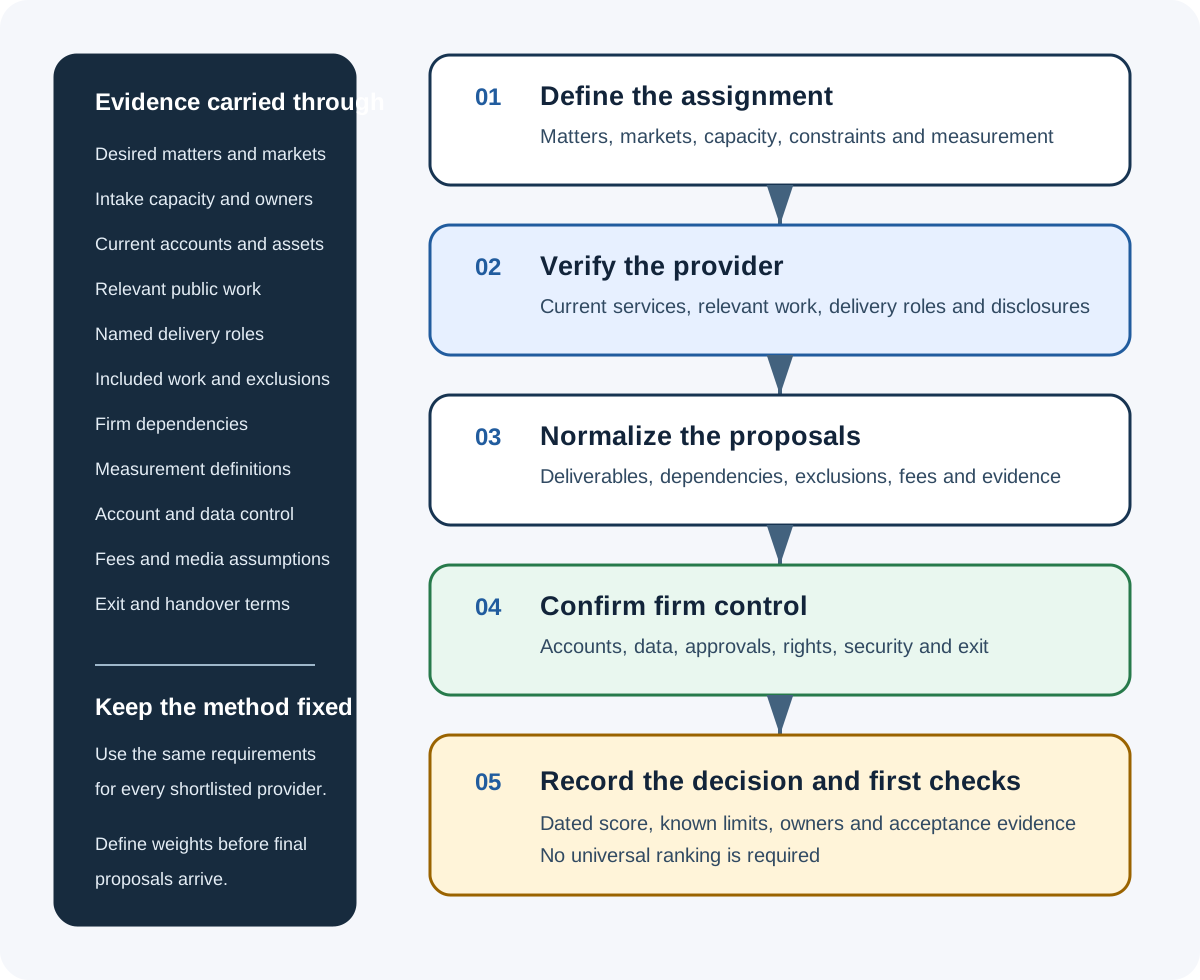
- Define the assignment: matters, markets, capacity, constraints and measurement.
- Verify the provider: current services, relevant work, delivery roles and commercial disclosures.
- Normalize the proposals: deliverables, dependencies, exclusions, fees and evidence.
- Confirm control: accounts, data, approvals, rights, security and exit.
- Record the decision: dated score, known limits, owners and first acceptance checks.
Download the law firm marketing agency comparison worksheet. It contains no provider names, rankings, scores, market rates or completed findings. Define the weights before entering proposal details.
A paid discovery or limited pilot can reduce uncertainty when the assignment can be separated cleanly. Define the deliverable, access, rights and acceptance test first. Do not use a pilot to place live legal claims or spend media without the firm's approval.
Before signing, the firm should be able to answer:
- Which matters and markets does the assignment support?
- Which work is included, dependent, optional or excluded?
- Who completes and reviews each deliverable?
- What evidence supports the provider's relevant experience?
- Which accounts and assets remain controlled by the firm?
- How will legal, factual and privacy approvals work?
- Which source systems define the report?
- How are qualified inquiries distinguished from raw activity?
- What changes require written approval?
- What does the firm receive when the engagement ends?
The final decision does not need a universal "best agency." It needs a provider, scope and control model that fit the firm's actual assignment. For a proposal from SWM, contact Small World Marketing and use the same questions in this guide.
Sources and limits
This guide relies on the following primary documentation:
- Google Ads account access levels;
- Google Search Console users and permissions;
- Google Analytics access management;
- Google Search Central guidance for useful, people-first content; and
- Office of the Privacy Commissioner of Canada guidance on assessing third-party service providers.
Platform roles, services and provider teams can change. Verify current primary documentation and proposal details before granting access or signing. This guide does not report an independent agency study, rank providers, state market prices, promise results or provide legal advice.