Two SEO proposals with the same monthly fee can buy very different work. Compare the pages, technical fixes, local search work, evidence, and reporting included before treating the cheaper quote as better value.
For a concrete Canadian reference, Small World Marketing's public pricing lists its Local plan at CAD $1,000 per month and Everywhere plan at CAD $2,000 per month, checked October 16, 2026. Those are SWM's advertised plans, not a Canadian law-firm market average or a quote for your firm. Local focuses on Maps; Everywhere lists website, organic, Maps and AI search work. A legal SEO proposal still needs to specify the actual work, exclusions and approval responsibilities.
The useful question is what it costs to deliver the work your firm needs, including the work outside the agency retainer. Start with a comparable scope, then compare price. For the wider budget, use our law-firm marketing cost guide.
What a monthly law-firm SEO fee actually buys
An SEO retainer should identify work on assets the firm can inspect: service pages, site problems, eligible business profiles, content, relevant public references and reporting. It should also explain whether the agency implements its recommendations. An audit PDF that waits for your developer is a different service from an agency that makes and tests the changes.
Google's guide to hiring an SEO recommends asking about methods, relevant experience, measurement and communication. Use those questions to request concrete deliverables and access to the evidence. A ranking promise is not a substitute for a work specification.
For example, 'family law SEO' could mean improving one existing divorce page, researching a new service-page structure, fixing indexing problems, managing a genuine office profile, or coordinating all four. The same label does not establish equivalent effort. Ask which URLs and accounts are in scope, which changes happen first, and who signs off on legal statements.
SWM's published prices as a starting reference
The following prices were checked on the SWM pricing page on October 16, 2026. They describe this agency's advertised services. They do not establish what other providers charge or what every law firm needs.
| Published SWM item | Advertised CAD price | Publicly listed scope | Clarify before approval |
|---|---|---|---|
| Local | $1,000/month | Google Maps, Business Profile, citations, reviews and reporting | Actual office/profile eligibility, implementation and reporting scope |
| Everywhere | $2,000/month | Website and organic SEO, Maps and AI search visibility | Page inventory, content/review process, technical implementation and priorities |
| Proactive Website Support | $49/month | Hosting, security, scans, revisions, email and support | Whether the proposed arrangement already includes it; support and recovery boundaries |
| Instant | $1,000/month | Google Ads management, a landing page and tracking | A separate paid channel; confirm media spend and avoid counting this as SEO |
Confirm currency, taxes, inclusions and current terms in the written proposal. These are public plan references, not a promise of legal review, unlimited pages, a custom website rebuild or any particular ranking. A multi-location or unusually complex project needs its own scope. We do not use a published starting price to invent a law-firm-specific package.
Separate setup work from recurring work
Setup addresses the starting condition of the website and accounts. That can include access recovery, an inventory of existing pages, measurement checks, a technical audit, priority fixes and a content plan. Recurring work should then describe what continues, what changes with findings, and how completion is checked.
Ask whether a setup charge buys work beyond the first month's retainer. A proposal that charges twice for the same audit needs clarification. Conversely, a low setup fee may leave implementation outside the contract. Make the distinction explicit rather than comparing only the first invoice.
Website replacement is another separate decision. A firm with a working site may need focused repairs and better service pages. A broken platform or difficult migration may need a project before a recurring program can usefully proceed. Our website cost guide and migration checklist help define those projects.
What changes the scope and cost
Use the firm's starting condition and service model to explain the budget. Practice-area labels alone are too broad to price the work.
| Scope driver | Evidence to bring to the proposal | Work it may create |
|---|---|---|
| Existing site condition | Crawl findings, affected URLs, indexing and intake tests | Repairs, redirects, templates or developer coordination |
| Services and jurisdictions | Actual matters accepted, lawyer coverage and current pages | Distinct service explanations and jurisdiction-specific review |
| Real offices | Genuine operating locations, existing profiles and account access | Profile reconciliation, appropriate location pages and local evidence |
| Content quality | Page inventory, source gaps and named reviewers | Rewriting, consolidation, research and lawyer review |
| Internal capacity | Available reviewer, developer and intake staff time | More agency implementation or a smaller achievable release plan |
| Competition and baseline | Dated search observations and the firm's own performance data | A reasoned sequence of improvements, without a guaranteed outcome |
A second city does not automatically justify duplicating the entire site. New location content should reflect real coverage and distinct evidence. Likewise, a long keyword list does not establish a need for hundreds of pages. The proposal should explain which reader task each page serves and how it differs from existing content.
Legal review is a capacity cost even when the firm performs it internally. Set a named reviewer, expected turnaround and approval record. Do not treat an agency's content writing as a replacement for the firm's review of service accuracy, confidentiality and applicable professional requirements. This guide compares marketing procurement; it does not approve a firm's compliance.
Compare the same deliverables across proposals
Send each provider the same page inventory and business goals. Ask them to complete this matrix in writing. A blank response identifies a question to resolve, not proof that the provider performs badly.
| Compare | What the proposal should state | Evidence or acceptance check |
|---|---|---|
| Fee and term | Currency, billing period, tax treatment, minimum term, cancellation and setup charges | Written fee schedule with inclusions and exclusions |
| Pages and content | URLs, intended audience, research, drafting, revisions and review owner | Reviewed copy and the published page, not only a word count |
| Technical work | Specific issues, implementation owner and developer allowance | Changed URLs and a repeatable before/after check |
| Local search | Actual profiles, eligibility, ownership and update responsibilities | Firm-controlled access and accurate public information |
| Authority work | Methods, proposed placements and any separate placement costs | Relevant, inspectable public references; no undisclosed bulk link package |
| Measurement | Organic landing pages, meaningful inquiries, fit and reporting definitions | Accessible reports and a documented attribution method |
| Ownership and exit | Accounts, authored work, data exports, subscriptions and handover | The firm can identify and access its assets and understand license limits |
Download the blank SEO quote comparison worksheet to record actual proposals. The worksheet contains questions and empty fields, not vendor scores or prefilled market prices. For more detailed deliverable checks, read the SEO proposal checklist.
Buying a fixed number of blog posts is easy to count. It can still leave the wrong service page ranking, a profile under someone else's control, or a contact notification failing silently. Ask the agency to show the complete path from the intended search to the page and a tested inquiry route.
Build the full budget before comparing retainers
Keep agency SEO fees, internal review, tools, one-time projects and paid advertising in separate rows. Do not hide the ad budget inside a single 'marketing cost' number. When a provider bundles services, ask for a clear boundary rather than assuming every line below is an additional charge.
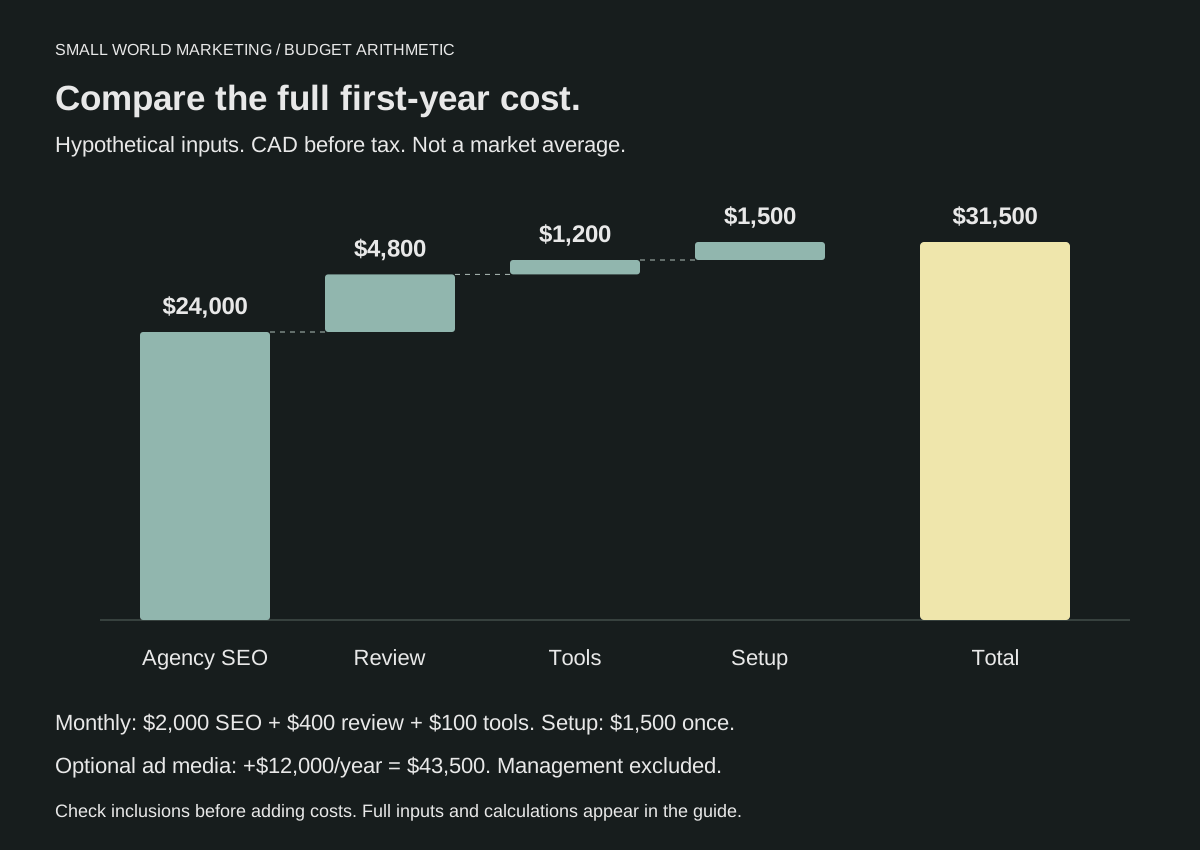
This graphic is arithmetic, not a market survey, recommended budget or customer quote. It uses a hypothetical $2,000 monthly SEO fee, $400 monthly review allowance, $100 monthly tools allowance and $1,500 one-time setup project. The retainer matches SWM's public Everywhere reference amount only; the other allowances and the assumed scope are invented solely to demonstrate budgeting. Confirm whether review, tools or setup are already included before adding them.
| Illustrative input | Calculation in CAD | First-year amount |
|---|---|---|
| Agency SEO fee | $2,000 × 12 months | $24,000 |
| Review allowance | $400 × 12 months | $4,800 |
| Separate tools allowance | $100 × 12 months | $1,200 |
| One-time setup project | $1,500 once | $1,500 |
| Total before tax, without advertising | $24,000 + $4,800 + $1,200 + $1,500 | $31,500 |
| Optional ad media | $1,000 × 12 months | Add $12,000; combined $43,500 |
Advertising management is not included in that optional media row. Neither are a new website, financing charges or taxes. The example assumes twelve paid months and no fee changes. Substitute the written scope and actual costs; an internal staff allowance is an economic cost and may not be a separate supplier invoice.
For a six-month comparison, calculate six recurring payments plus the applicable setup and project charges. Do not simply divide the first-year total in half when a one-time charge is involved. In this example, six months without advertising is $2,500 × 6 + $1,500 = $16,500 before tax.
Measure cost per qualified inquiry carefully
Agree on what the firm counts as a qualified inquiry before judging a program. A useful definition might require a new prospective client, a service the firm actually provides and a jurisdiction the firm can serve. Deduplicate repeat calls and separate existing-client contacts, job applications and spam.
For a stated reporting period, cost per qualified organic inquiry = the SEO costs assigned to that period ÷ the number of qualified inquiries attributed to organic search. Keep paid-search inquiries out of the organic denominator. If the agency fee covers Maps and other discovery channels together, document how the budget and inquiries are grouped instead of implying a precise channel split that the data cannot support.
An arithmetic illustration: $2,500 of recurring program and review/tool costs divided by 10 qualified inquiries is $250 per inquiry. With 25 inquiries and the same cost, it is $100. These are hypothetical counts, not SWM results or a forecast. If there are zero qualified inquiries, report the spend and zero count; there is no finite cost-per-inquiry result to present.
Record the first contact source, landing page where available, qualification decision and reporting window. Multi-touch journeys, missing tracking and people who return directly limit attribution. A signed client is another stage with its own lag and intake decisions. An inquiry calculation does not establish profit, lifetime client value or causation.
Include AI search work without paying for unsupported promises
Ask what the AI search deliverable changes on the website and how observations are recorded. Google's AI feature guidance says its normal SEO foundations remain relevant and that special AI markup is not required. That statement concerns Google's AI features; it does not establish identical rules across every assistant.
A useful proposal separates site improvements, observed mentions, linked citations, referral visits and inquiries. It should not sell a technical score as proof that ChatGPT recommends the firm. Our AI visibility guide explains those measurement boundaries, and our GEO service page describes the broader service.
Decide with scope, evidence and control
Choose the proposal that clearly connects the firm's actual needs to deliverables it can inspect and afford to support. Price matters. So does knowing who writes, implements, reviews, owns and verifies the work.
Bring the existing site, actual offices, services, reviewer availability and recent inquiry data to the discussion. We can use those inputs to scope law-firm marketing and SEO without treating an advertised plan as a complete diagnosis. Request a review with the priorities and constraints you already know.
Sources and price check
- SWM pricing: agency-published CAD plan prices checked October 16, 2026. Confirm the current written proposal before buying.
- Google Search Central: Do you need an SEO?: hiring and evaluation guidance checked October 16, 2026.
- Google Search Central: AI features and your website: scope of Google's AI search guidance checked October 16, 2026.
All budgets, inquiry counts and computed costs explicitly labelled illustrative above are constructed examples. No Canadian market-average study, competitor pricing survey or new client performance claim is presented.