An editorial calendar should make the next useful page obvious and give the responsible reviewer enough time to approve it. It should also reserve capacity for maintaining pages that already serve clients. A monthly quota of new posts does neither.
The calendar is an operating record, not a list of titles. Each row should connect a real client task to a destination, evidence standard, reviewer, publication gate and maintenance trigger. If those fields are missing, the date is only a guess.
Small World Marketing sells content strategy, writing and publication services to law firms. That is a commercial interest. This guide shows the planning and review controls we would expect in a useful editorial system. It does not provide legal advice, promise search results or replace the responsible lawyer's approval.
Inventory the current site before adding topics
Start with the pages the firm already owns. A content calendar built without an inventory can create duplicate pages, disconnected articles and new work that should have been an update.
The inventory does not need to be complicated. Record the live URL, page purpose, intended reader, practice and jurisdiction, current owner, last substantive review, primary internal links and known issue. Add performance context only where the firm has reliable access and a defined comparison period.
Give every important page one intended job. A service page can establish what the firm handles and how to contact it. A practice-area guide can help a reader understand a narrower problem. A lawyer profile can establish relevant people and approved credentials. A preparation resource can support the next step. One page may help with several tasks, but its main purpose should be clear.
Classify each destination:
- keep and maintain;
- update for accuracy or usefulness;
- consolidate into a stronger destination;
- redirect after an approved URL decision;
- create because a material reader task is missing; or
- hold until evidence, service scope or review is available.
Do not delete or change a URL because it received little traffic in one short period. Check its role, links, history, service value and replacement destination. Do not change a displayed date unless the content was substantively reviewed or changed.
| Inventory field | Question it answers | Evidence to retain | Accountable owner | Calendar decision |
|---|---|---|---|---|
| Page purpose | What should this destination help a reader do? | Approved page brief or current-page review | Marketing owner | Keep, update, consolidate or create |
| Service scope | Does the firm actually offer the described work? | Practice leader's current service list | Responsible lawyer | Publish, narrow or hold |
| Jurisdiction | Where does the explanation and service apply? | Current primary sources and approved firm facts | Responsible lawyer | Confirm, split or qualify |
| Reader task | Which decision or preparation step does the page support? | Intake themes, approved questions and page intent | Marketing and intake owners | Prioritize or defer |
| Evidence | Can important statements be traced and approved? | Source register and firm-fact register | Researcher and reviewer | Refresh or hold |
| Internal relationship | Which service, lawyer and related resources should connect? | Link map with live destinations | Editor or publisher | Add, remove or redirect links |
| Current condition | Is the page accurate, readable and technically sound? | Rendered review, accessibility checks and technical evidence | Publisher | Repair, rebuild or maintain |
| Outcome context | What can the firm actually observe? | Search Console, analytics and approved intake definitions | Measurement owner | Investigate, test or preserve |
The law firm practice area page guide provides a more detailed copy and approval checklist. Use the law firm content agency guide when an outside provider will research, write or publish the work.
Choose themes from services and client questions
Themes should come from work the firm is prepared to accept and questions the intended audience genuinely needs answered. Search data can help validate wording and discover gaps, but it should not turn the calendar into a list of isolated keywords.
Build themes from four sources:
- service and practice priorities approved by the firm;
- recurring client questions that can be discussed publicly;
- gaps or maintenance needs found in the inventory; and
- current primary-source changes that affect existing explanations.
Separate the source from the conclusion. An intake team may report that callers often misunderstand a process. That is a useful theme signal, not proof that a new article will generate retained matters. Search Console may show impressions for related queries. That is search-result evidence, not a complete measure of demand or client value.
Before adding a new destination, check whether an existing page should answer the question. A new section, table, internal link or refreshed explanation may be better than another URL.
Use a short prioritization record instead of an invented score:
- intended reader and task;
- practice and service relationship;
- existing destination or confirmed gap;
- evidence available now;
- responsible legal and editorial reviewers;
- expected production effort;
- maintenance sensitivity; and
- observable reason to revisit the decision.
A low-effort topic should not jump the queue merely because it is easy to publish. A high-value legal explanation should not receive a date until its sources and reviewer are available.
Google's people-first content guidance asks whether content serves an existing or intended audience, shows useful expertise and helps a reader achieve a goal. It also warns against producing many topics mainly to attract search visits, writing to a preferred word count, or changing dates to appear fresh when the content did not materially change. Those are useful calendar guardrails.
Plan capacity across a 12-month cycle
A 12-month view is useful for capacity and maintenance. It should not lock the firm into 12 invented topics.
Use rolling months rather than assuming every practice follows the same seasonal pattern. Reserve capacity before assigning titles. A practical mix can include new priority pages, substantive updates, link and navigation work, source monitoring, conversion-path checks and technical maintenance. The exact mix depends on the inventory and reviewer capacity.
| Planning month | Primary portfolio task | Evidence or decision required | Review reservation | Maintenance reservation |
|---|---|---|---|---|
| Month 1 | Complete inventory and page-purpose decisions | Current URLs, owners and service scope | Practice and marketing leads | Repair broken critical links |
| Month 2 | Brief the first approved gap | Intended reader, task, destination and sources | Named legal and editorial reviewers | Refresh one high-risk page |
| Month 3 | Publish only after acceptance checks | Approved copy, assets, links and technical record | Intake and publisher review | Verify Month 2 live changes |
| Month 4 | Review page relationships | Link map and consolidation decisions | Practice owners for affected pages | Update related links and redirects |
| Month 5 | Brief the next approved service need | Current firm facts and primary sources | Reviewer capacity confirmed | Review lawyer and office facts |
| Month 6 | Portfolio review | Six-month change record and known limits | Marketing and practice leads | Refresh or hold aging claims |
| Month 7 | Improve an existing client resource | Reader task, feedback and source review | Subject reviewer | Test contact and download paths |
| Month 8 | Address a confirmed gap | Inventory decision and distinct page purpose | Legal, editorial and intake owners | Recheck related content |
| Month 9 | Review implementation quality | Rendered content, accessibility and link checks | Publisher and editor | Repair template or asset issues |
| Month 10 | Update changing-source content | Current official sources and effective dates | Responsible lawyer | Record next source trigger |
| Month 11 | Reconcile search and intake evidence | Defined periods, pages, queries and approved intake categories | Measurement and practice owners | Investigate tracking gaps |
| Month 12 | Replan the portfolio | Keep, update, consolidate, create and hold decisions | Accountable owners for next cycle | Archive decisions and assign owners |
This is a planning pattern, not a required publishing frequency. A firm with one reviewer may schedule fewer releases. A firm with several practices may run parallel review lanes, but each destination still needs a named owner and version-specific approval.
Download the 12-month law firm editorial calendar worksheet. It contains blank planning rows and no completed priorities, legal conclusions, search volumes or performance forecasts.
Put research and review dates before the publish date
Working backwards from a public date reveals whether the plan is possible.
Each item should have separate dates or states for:
- destination and brief approval;
- primary-source research;
- firm-fact collection;
- first draft;
- editorial review;
- legal or subject review;
- intake and claim review where relevant;
- revision and final approval;
- technical implementation;
- pre-publication acceptance;
- live verification; and
- the next maintenance trigger.
Do not use "client review" as a role. Name the person or accountable function. A practice leader may approve legal substance, a marketing owner may approve positioning, an intake owner may approve contact instructions and a publisher may own rendering and release checks.
Silence is not approval. The calendar should distinguish requested, in review, changes required, approved, held, implemented and live verified. If the source changes after approval, reopen the relevant gate.
The production date should remain movable until evidence and approvals are complete. A missed date is less costly than publishing unsupported legal or firm claims.
Use one visible publishing pipeline
The pipeline below keeps planning, research, review, implementation and maintenance connected.
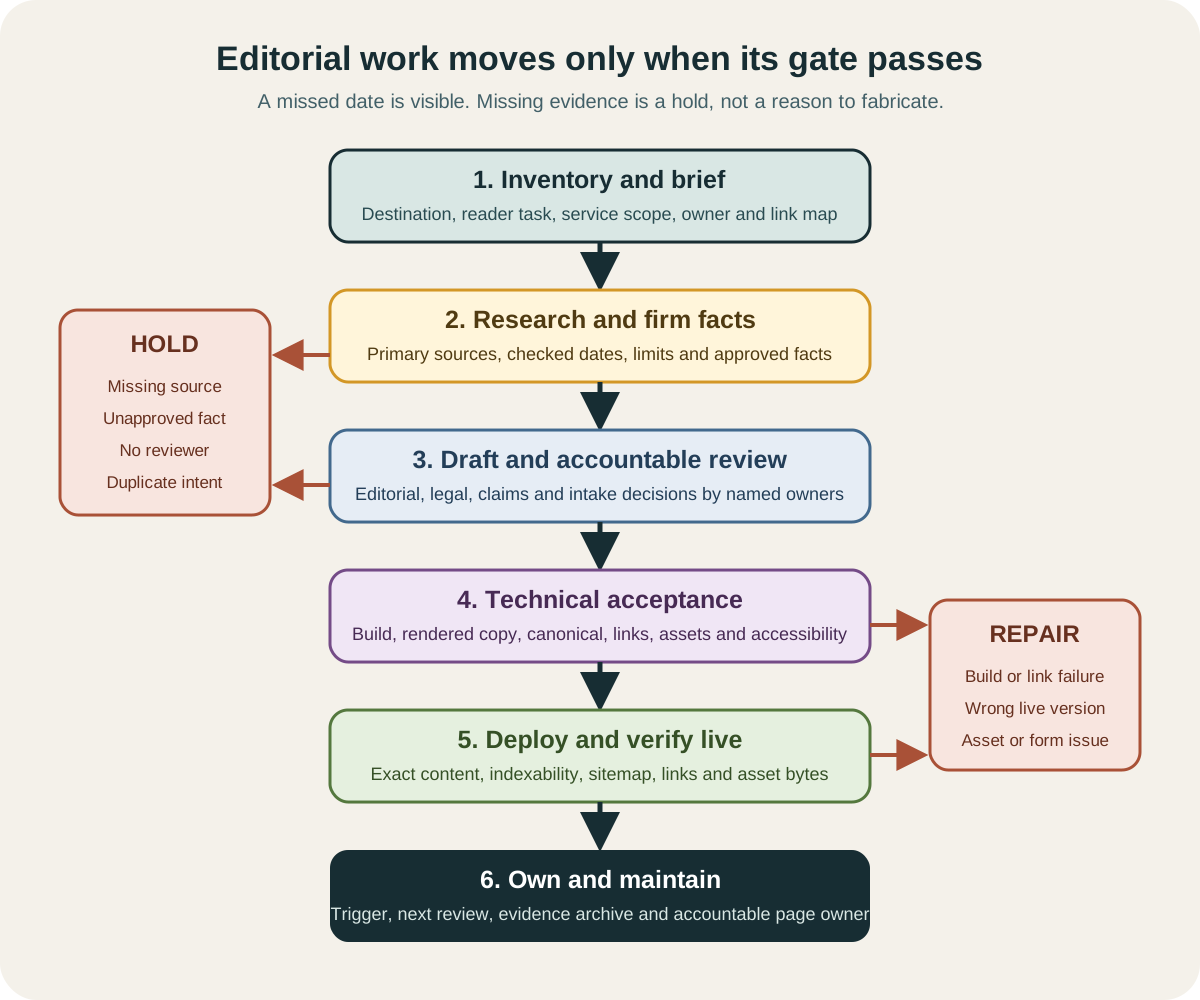
The handoff record should include:
- the destination and intended reader task;
- the source register and approved firm facts;
- the current draft and open questions;
- the named reviewers and decision status;
- internal links, graphic and download requirements;
- the implementation and build result;
- the public verification receipt; and
- the owner and trigger for the next review.
Keep the approved source version. If someone changes legal substance, a professional claim or contact instruction during implementation, the item returns to review.
Schedule refreshes by risk and trigger
Not every page needs the same review frequency. Use risk and change triggers.
Pages with changing legislation, procedural rules, fees, deadlines, platform requirements, people, offices or intake instructions need closer ownership. Evergreen explanations may need less frequent review, but broken links, changed services and technical failures still create maintenance work.
Useful triggers include:
- a law, regulation, court, tribunal or professional rule changes;
- the firm adds, removes or narrows a service;
- a lawyer, designation, office, phone number or intake route changes;
- a cited source is replaced or withdrawn;
- an internal destination moves;
- Search Console shows a material page/query change worth investigating;
- an intake owner reports that a page sends the wrong inquiries;
- accessibility or technical testing finds a defect; or
- a planned periodic review comes due.
A trigger should open a review task, not automatically overwrite the page. The reviewer first decides whether the change is material.
Record what changed. A maintenance log can state that sources were rechecked with no substantive edit. Do not update the public date merely to make the page look recent.
Plan internal links with the content, not after it
Every planned page should have an inbound and outbound relationship.
The brief should identify the parent service page, related resources, useful profiles and next-step destination. Check that each target is live, canonical and relevant. Use concise, descriptive anchor text.
Google's current link guidance says crawlable links and descriptive anchor text help people and Google understand destinations. It also recommends that every important page have a link from at least one other page and says there is no magic ideal number of links. That supports a reader-first link map, not a fixed link quota.
The law firm content marketing page is the service hub for this guide. The law firm marketing page connects the broader strategy. The law firm conversion guide covers the path from a page to a working inquiry.
When consolidating pages, update the calendar with the final destination, redirect decision and affected internal links. Do not let an old URL remain in new briefs after the destination changed.
Measure distribution and inquiry outcomes separately
Measurement should help the firm make a decision. It should not turn every page into a ranking promise.
Google Search Console's Performance report provides clicks, impressions, click-through rate and average position. It can group data by dimensions including queries, pages, countries, devices, search appearance and dates. Record the property, filters, date range and comparison method before interpreting the numbers.
Search Console data describes Google Search activity. It does not show whether an inquiry was qualified or became a retained matter. Analytics events also need testing. A form-submit event can fire even when notification delivery fails.
Define the stages the firm can actually observe:
- page viewed or search click;
- contact action;
- received inquiry;
- qualified inquiry;
- consultation scheduled;
- consultation attended; and
- retained matter where the firm can lawfully and reliably record it.
Use the minimum approved information needed. Keep client details out of the editorial calendar. Aggregate or classify intake feedback using the firm's approved privacy and professional controls.
Review each item against its purpose. A preparation guide may be valuable because it reduces repeated explanations. A practice page may support qualified inquiries. A source update may protect accuracy even when traffic is unchanged.
| Review gate | Accountable owner | Required artifact | Hold condition | Completion evidence |
|---|---|---|---|---|
| Inventory decision | Marketing and practice owners | Current URL and purpose record | Existing relationship is unresolved | Keep, update, consolidate, create or hold decision |
| Brief approval | Practice and marketing owners | Reader, task, destination, scope and link map | Page duplicates an existing intent | Approved brief |
| Evidence review | Researcher and subject reviewer | Primary-source and firm-fact registers | Important statement lacks support | Dated source record and resolved questions |
| Legal and claims review | Responsible lawyer | Version-specific legal and professional-claim decision | Required review is missing | Named approval or documented hold |
| Intake review | Intake owner | Contact wording and approved route | Next step is inaccurate or untested | Synthetic test and handoff result |
| Editorial review | Editor | Structured, original and useful final draft | Copy is generic, repetitive or outside scope | Resolved edit record |
| Technical acceptance | Publisher | Build, rendered page, canonical, sitemap, links, assets and accessibility checks | Any acceptance check fails | Pre-publication verification record |
| Live verification | Publisher | Public content and asset checks | Deployment differs from approved version | Commit, deployment and verification receipt |
| Maintenance assignment | Page owner | Trigger and next review record | No accountable owner exists | Calendar entry and source archive |
Apply professional rules to the calendar
The responsible lawyer should identify the rules that apply to the firm and each publication.
For one jurisdiction-specific example, Law Society of British Columbia rule 4.2-5 says a lawyer's marketing activity must not be false, inaccurate, unverifiable, reasonably capable of misleading, or contrary to the best interests of the public. Its commentary includes marketing likely to create an unjustified expectation about results. That is a BC example, not a national summary of every firm's obligations.
Put the rule review where it can change the work:
- in the brief for claims that require evidence;
- in the source register for changing statements;
- in the reviewer field for accountable approval;
- in the hold status when approval is missing; and
- in the maintenance trigger when the source or firm fact changes.
An editorial calendar cannot approve a legal claim. It can make the missing approval visible before publication.
Run the calendar as a decision record
A useful monthly review can stay short:
- Confirm the highest-priority client and service tasks.
- Review open evidence and approval holds.
- Check releases awaiting technical or live verification.
- Reserve capacity for triggered maintenance.
- Review search and intake evidence with its limits.
- Change the plan where evidence or capacity changed.
- Record owners and next actions.
Do not reward the team only for publishing count. Track useful work completed: a source updated, a duplicate consolidated, an intake path repaired, a critical page approved, a live destination verified or a missing evidence item held instead of fabricated.
For help building and operating the system, contact Small World Marketing. Apply the same evidence, ownership and review requirements to our proposal.
Sources and limits
This guide relies on the following primary documentation checked on November 9, 2026:
- Google Search Central guidance for helpful, reliable, people-first content;
- Google Search Central link best practices;
- Google Search Console Performance report documentation; and
- Law Society of British Columbia, Chapter 4 marketing rules, used only as one jurisdiction-specific example.
The responsible lawyer must review legal substance, professional claims, service scope and jurisdiction-specific obligations. The firm must approve its own facts, intake process and measurement controls. This guide does not provide legal advice, state market demand, report search volumes, present an audit or promise rankings, inquiries or retained matters.