A law firm should know who researches a page, which sources support it, who checks the legal substance, and what the firm receives at the end. Those operating details matter more than a promised article count.
This guide covers content agencies and individual writers. The right choice depends on the assignment. A specialist writer may fit a controlled set of articles with a firm editor. An agency may fit a larger inventory that also needs briefs, interviews, editing, graphics, publication, internal links, measurement and maintenance.
Small World Marketing publishes this guide and sells law firm content marketing services. That is a commercial interest. This is not an independent provider ranking, and it does not name or score competitors. The framework is designed so a firm can use the same requirements for SWM and every other proposal.
Define the content inventory before requesting proposals
Start with the pages the firm needs and the decisions each page should help a reader make. A request for "four blogs a month" describes a production rhythm. It does not define the work.
List the current service pages, lawyer profiles, location pages, frequently asked questions, articles, intake resources and downloadable materials. Mark which pages should remain, which need factual updates, which overlap, and which client questions have no useful destination. Include the page owner and the date of the last substantive review.
The inventory should connect content to real client tasks. A family law page may need to explain whether the firm handles a particular matter, the jurisdiction served, the information needed for an initial call, and the next step. A short article about a new rule has a different purpose and maintenance cycle. Combining both under one word count hides the difference.
Use the existing law firm content marketing service page to frame the full inventory. The law firm marketing hub shows how content connects to search visibility, local presence, websites and intake.
| Content type | Reader task | Evidence the brief should provide | Firm input | Acceptance check |
|---|---|---|---|---|
| Practice or service page | Decide whether the firm handles the matter | Current law, firm scope, jurisdiction and approved differentiators | Lawyer interview and service boundaries | Responsible lawyer confirms scope, facts and claims |
| Lawyer profile | Understand experience and fit | Verified biography, credentials, representative work approved for use | Lawyer and firm records | Names, dates, links and professional claims are accurate |
| Location page | Confirm real service coverage | Genuine office or service facts and distinct local information | Address, coverage and intake process | No invented office, ranking or local experience |
| Educational guide | Complete a specific information task | Primary sources, definitions, examples and limits | Subject reviewer and client questions | Sources support the substance and links work |
| News or rule update | Understand a dated change | Current official source and effective date | Jurisdiction-specific review | Publication date, scope and update trigger are visible |
| Intake resource | Prepare for an appropriate next step | Approved instructions and privacy-aware fields | Intake owner and technical owner | Form, download, notification and handoff are tested |
Ask each provider to price the same inventory or clearly state which part it will handle. A provider can propose a better structure, but the proposal should show what is being replaced, consolidated or added.
Specify the research standard and firm facts
The content brief should name the jurisdiction, intended reader, page purpose, questions to answer, primary sources to consult, firm facts that require confirmation, and claims that require a lawyer or other accountable reviewer.
Primary sources differ by subject. Legislation, regulations, court or tribunal decisions, law society materials, government guidance and official platform documentation can support different statements. A search result, another firm's article or an AI response may help find a source. It should not silently become the authority for a legal or factual claim.
The brief also needs a method for firm-specific facts. A writer should not infer that the firm serves every city in a province, handles every matter in a practice category, offers a free consultation, has a certain success rate, or can promise an outcome. Those details must come from an approved firm source.
Google's people-first content guidance asks whether a page serves an intended audience, demonstrates useful expertise, leaves the reader able to achieve a goal, and makes the creator and production method understandable where readers would expect that information. Those questions are useful editorial checks. They are not a substitute for legal review or evidence.
Require a source register with the draft. At minimum, it should record the URL or citation, publisher, title, relevant point, date checked, jurisdiction, and any limitation. The reviewer should be able to trace an important statement without repeating the writer's search from the beginning.
Inspect samples, then run a paid writing test
Portfolio samples show presentation. They do not always show who completed the research, how much editing the agency added, whether the client supplied the substance, or whether the named writer will work on the new account.
Ask for one or two relevant samples and the production context. The provider can remove confidential details, but it should still explain the assignment, its role, the source standard, the review process, and whether the sample is representative of the proposed team.
A paid test gives both sides a defined assignment. Use a real topic only when the firm can safely share the required facts and sources. Otherwise use a fictional or general topic that tests the same skills. Do not use prospective-client information, privileged material or unapproved case details as sample content.
Give every shortlisted provider the same test brief, reasonable time, compensation and evaluation criteria. A hidden test of unpaid work is a poor start to the relationship.
| Test area | What to provide | What to inspect | Evidence to retain | Common failure |
|---|---|---|---|---|
| Reader and purpose | Named audience and task | Opening, scope and next step | Brief and submitted draft | Generic introduction with no decision to support |
| Research | Required primary sources and date | Source quality, accuracy and traceability | Source register and links | Secondary summaries used as authority |
| Firm facts | Approved fact sheet | Correct use of services, locations and claims | Reviewer comments | Facts inferred or embellished |
| Structure | Required questions and page relationship | Headings, order, useful tables and internal links | Outline and revision notes | Word count padded with repeated definitions |
| Legal review | Marked review points | Clear questions for the responsible reviewer | Approval record | Writer presents marketing review as legal approval |
| Editing | One revision round with specific feedback | Accuracy, judgment and response to comments | Version history | Surface edits that ignore the substance |
| Originality | Required analysis or useful tool | Distinct value beyond source summaries | Similarity check and editor review | Competitor structure rewritten without added value |
| Delivery | Named format and deadline | Clean files, accessible tables and usable links | Final package | Copy pasted without assets, sources or ownership notes |
Score the test only after the criteria and weights are fixed. A polished tone should not erase a missing source. One awkward sentence should not outweigh a strong, correct research process that can be edited.
Compare an individual writer with an agency
An individual writer can be the right choice when the firm already owns strategy, briefs, subject interviews, editing, publication and measurement. The proposal should still identify backup coverage, availability, source practices, revisions and rights.
An agency can coordinate more of the system. That can include inventory planning, keyword and client-question research, briefs, interviews, writing, editing, design, development, internal links, publication and reporting. The broader scope costs more to deliver and creates more handoffs to inspect.
Neither label proves quality. A large agency may pass work through several unknown roles. A specialist writer may have a disciplined research and revision process. Ask who will perform each task, not only which company signs the agreement.
If the content provider also changes the website, include technical acceptance. Confirm draft and production environments, URL ownership, redirects, canonical tags, metadata, structured data where appropriate, internal links, image alternatives, responsive tables and form behavior. The website redesign guide covers launch and migration controls. The conversion guide covers the path from a page to a working inquiry.
Build a visible research and approval workflow
The workflow should make status visible without treating every draft as approved. A useful set of states is briefed, researching, drafting, editorial review, firm fact review, legal or subject review, approved, implemented, technically checked and scheduled for maintenance.
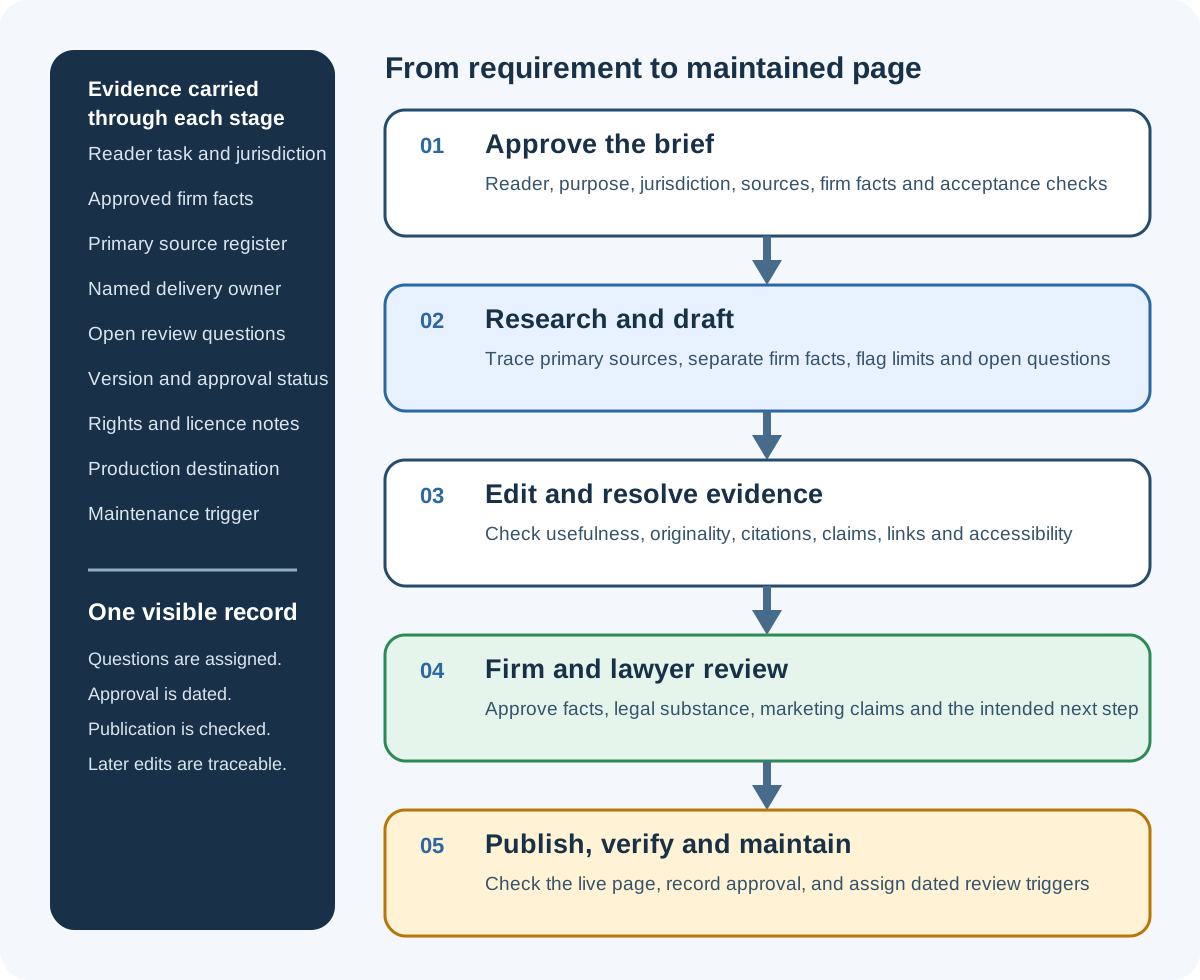
The responsible reviewer should be named in the brief. "Client review" is not a role. A practice leader may approve legal substance, a marketing owner may approve positioning and links, and an intake owner may approve contact instructions. One person can fill several roles, but the decision should be explicit.
Separate questions from approvals. The writer should flag uncertain jurisdiction, scope, facts and claims in a review list instead of burying them in comments across several documents. The reviewer should answer, reject or assign each item. Silence is not approval.
Set a version rule. Approved copy should have a dated source file and a production destination. Later changes should identify who made them and whether they reopened legal or factual review. This prevents a correct approved draft from being changed during publication without another check.
Protect confidential information and control the tools
A content provider usually does not need prospective-client details, privileged communications or a full case file. Use the minimum information needed for the approved task. Replace real personal information with synthetic examples when testing forms, workflows or AI tools.
The Office of the Privacy Commissioner of Canada's September 2026 third-party provider guidance recommends assessing providers before they handle personal information. It covers data flows, purposes, subprocessors, locations, security, monitoring, retention, deletion and exit. The guidance was open for comment until December 4, 2026 when this page was prepared, so the firm's privacy lead or lawyer should check the current version and the law that applies to the actual arrangement.
Ask the provider which writing, transcription, storage, project-management, analytics and AI tools will receive firm information. Confirm what is stored, where it goes, who can access it, whether it is used for training, how long it remains, and what happens at termination. A generic statement that a tool is secure is not a data-flow map.
Keep firm-controlled access where practical. Use named users and supported roles for the CMS, repository, analytics, Search Console, media library and project system. Do not make a provider's personal account the only administrator for a durable firm asset.
Confirm ownership, licences and handover
The agreement should distinguish ownership from permission to use. The Canadian Intellectual Property Office explains that an assignment transfers some or all rights, while a licence permits use under stated conditions and leaves ownership with the owner. The firm's lawyer should review the actual agreement, including moral rights, third-party materials and jurisdiction-specific terms.
Ask what the firm receives for each deliverable:
- approved text in an editable format;
- briefs, source registers and interview notes that may be retained;
- original graphics and accessible exports;
- licences and attribution requirements for stock or commissioned assets;
- prompts, structured data, templates or code included in the scope;
- revision and approval history;
- publication details, URLs and redirect records; and
- a clean export when the engagement ends.
Do not assume that paying an invoice transfers every underlying asset. A provider may use licensed fonts, stock media, software components or internal templates that cannot be assigned. That can be acceptable if the proposal identifies the limitation and the published work can continue operating lawfully.
Normalize scope, fees, exclusions and reporting
Compare proposals line by line. One monthly fee may include research, interviews, writing, graphics and implementation. Another may include drafts only. Article counts and word counts are not comparable until the work around them is visible.
| Scope area | Included deliverable to request | Firm dependency | Acceptance evidence | Exit deliverable |
|---|---|---|---|---|
| Inventory and strategy | Page inventory, purpose, priority and consolidation decisions | Service priorities and current performance context | Approved inventory with owners | Current inventory and decision record |
| Briefing and research | Brief, source standard and source register | Firm facts and subject access | Traceable primary sources and open questions | Briefs and reusable research records |
| Writing and editing | Named draft, edit and revision rounds | Timely reviewer feedback | Version history and resolved comments | Approved editable copy |
| Legal or subject review | Review queue and approval record | Accountable firm reviewer | Dated approval or documented hold | Approval history and unresolved risks |
| Design and media | Tables, diagrams, images and alternative text | Brand assets and factual checks | Responsive and accessible review | Source files, exports and licence register |
| Publication | Metadata, internal links, implementation and checks | Website access and release approval | Rendered page, canonical, sitemap and live links | URL list and technical record |
| Measurement | Definitions, source systems and commentary | Intake feedback and approved data access | Reproducible report with known limits | Exported history and definitions |
| Maintenance | Review triggers, owner and response scope | New law, services and firm facts | Dated review log | Updated inventory and source files |
Record fees and currency, recurring cadence, minimum term, revision limits, rush work, interview time, design, development, software and third-party costs. Do not use a market-average price invented from unrelated packages. Compare the total scope the firm actually needs.
Reporting should show completed work, approvals, source limits, page changes, technical checks and the next owner. Traffic and rankings can help diagnose distribution. They do not prove that a legal statement is correct or that an inquiry became a retained matter.
Run one structured selection process
Send the same requirements to every shortlisted provider:
- Define the inventory, audience and reader tasks.
- Set the primary-source and firm-fact standard.
- Inspect relevant samples and production context.
- Run the same paid test with fixed criteria.
- Map the delivery team, review roles and tools.
- Normalize included work, dependencies, exclusions and fees.
- Confirm access, information handling, rights and exit.
- Record the decision, limits and first acceptance checks.
Download the law firm content provider comparison worksheet. It is blank and contains no provider names, scores, rates or completed findings. Define the requirements and weights before proposals arrive.
The provider should be able to explain the work without hiding behind a content calendar. A useful engagement leaves the firm with accurate pages, traceable sources, controlled assets and a repeatable review system.
For a proposal from SWM, contact Small World Marketing and apply the same questions in this guide.
Sources and limits
This guide relies on the following primary documentation:
- Google Search Central guidance for helpful, reliable, people-first content;
- Office of the Privacy Commissioner of Canada guidance on assessing third-party service providers;
- Canadian Intellectual Property Office guidance on transferring copyright ownership;
- Canadian Intellectual Property Office guide to copyright; and
- Law Society of British Columbia, Chapter 4 marketing rules, used as one jurisdiction-specific example rather than a national rule.
Platform guidance, professional rules and provider practices can change. The responsible lawyer must review legal substance, marketing claims and jurisdiction-specific obligations. This guide does not rank providers, report a market study, state average prices, promise results or provide legal advice.