A practice area page should help a prospective client understand whether a legal problem fits the firm's work, what information may matter, and what appropriate next step is available. It should also give the firm a page that can be sourced, reviewed, linked and maintained.
Generic legal copy fails when it could sit unchanged on almost any firm's website. Statements such as "we understand this is difficult" and "our experienced team can help" do not establish the matter, jurisdiction, service boundary, process or evidence behind the claim. More words do not repair that gap. Specific, approved information does.
Small World Marketing writes and publishes law firm content. That is a commercial interest. This guide explains the structure and review controls we would expect for a practice area page, but it does not provide legal advice, replace the responsible lawyer's review or promise search or client-acquisition results.
Start with the matter, reader task and jurisdiction
Do not begin with a keyword and a target word count. Begin with a real service the firm is prepared to deliver and a reader task the page can support.
Define the matter narrowly enough to make the page useful. "Business law" may be a service category, but a prospective client may need to assess a shareholder dispute, review a purchase agreement or organize a corporate reorganization. One page cannot answer every question for every business without becoming a directory.
Record the intended reader and stage. A person deciding whether to contact a lawyer needs different information from an existing client preparing documents. A page can support more than one task, but its primary task should be clear.
Name the jurisdiction and service limits. The copy should not imply that one legal rule, court process or firm service applies everywhere. If the firm serves several jurisdictions, decide whether the page can accurately explain the common scope or needs separate reviewed pages.
Before drafting, approve these inputs:
- the practice and specific matter types included;
- exclusions or related matters handled by another team;
- the jurisdictions and locations the firm can genuinely serve;
- the intended reader and decision the page supports;
- the approved lawyers, offices and intake route;
- firm facts, credentials and claims that may be stated;
- primary sources and their checked dates; and
- the responsible legal, marketing and intake reviewers.
The law firm content marketing service page explains SWM's commercial scope. The content agency selection guide explains how to inspect a provider's research and review process.
| Page input | Question to answer | Approved evidence | Reviewer | Acceptance condition |
|---|---|---|---|---|
| Matter scope | Which problems and services belong here? | Practice leader's approved service list | Responsible lawyer | Included and excluded matters are explicit |
| Intended reader | Who is this page for and what are they trying to decide? | Intake themes and approved audience definition | Marketing and intake owner | Opening supports a named reader task |
| Jurisdiction | Where can the firm provide this service? | Licensing, office and service facts supplied by the firm | Responsible lawyer | Copy does not imply unsupported coverage |
| Legal explanation | Which rules or process steps are necessary to understand the service? | Current primary sources with checked dates | Responsible lawyer | Important statements are traceable and qualified |
| Firm claim | What may be said about the team, experience or process? | Approved biographies, records and claim register | Marketing and legal reviewer | Claim is accurate, supportable and not misleading |
| Next step | What should an appropriate reader do? | Approved intake route and office instructions | Intake owner | Link, phone and form path work |
| Maintenance | What change should reopen review? | Source, service and staff ownership record | Page owner | Owner and review trigger are recorded |
Use a page structure that answers client questions
A useful structure moves from fit to substance to next step. The exact order can change, but each section needs a job.
State the service and limits early
The opening should identify the matter and the firm service in plain language. It can acknowledge the reader's situation without pretending to know personal facts. Avoid dramatic claims about urgency, risk or likely outcomes unless the page has an approved and properly qualified basis.
If the page covers only advice, only litigation, only transactions or a limited part of a process, say so. A precise boundary is more useful than a broad promise.
Explain the questions that determine fit
List the issues a lawyer would ordinarily need to understand at a high level: parties, dates, documents, location, procedural stage or business objective. This is not a substitute for advice. It helps the reader recognize what information may affect the next conversation.
Do not turn the page into an intake form. A public page can describe useful preparation while the firm keeps sensitive details inside an approved contact process.
Describe the service without guaranteeing a path
Explain what the firm may do, such as review documents, identify options, negotiate, prepare an application or appear in a proceeding. Use conditional language where the work depends on facts, instructions or procedural posture.
Do not describe one fixed sequence as if every matter follows it. If the process has branches, name the decision points and the limits of the overview.
Answer the recurring questions
Questions can make a page easier to scan, but they must be real questions supported by the firm's work and source review. Avoid manufacturing a long FAQ to repeat keywords.
Answers about deadlines, fees, outcomes or legal rights need special care. If a complete answer depends on facts or jurisdiction, explain that dependency. Do not invent an average fee or a standard timeline to fill a content template.
Connect the page to people and next steps
Link to the approved lawyer or team profiles that genuinely support the service. Use descriptive link text so a reader understands the destination. Google's current link guidance also recommends concise, descriptive anchor text in crawlable links.
The call to action should say what the firm offers next. Do not say "free consultation," "available 24/7" or "speak to a lawyer today" unless the firm has approved and can deliver that statement.
Replace generic copy with approved detail
Generic copy is not only a style problem. It hides missing decisions. The repair is to identify the absent fact, source or owner.
| Generic copy problem | What is missing | Better editorial approach | Evidence or approval needed |
|---|---|---|---|
| "We handle all family law matters" | Actual service boundary | Name the reviewed matter types and related exclusions | Practice leader's service list |
| "Our experienced lawyers get results" | Meaning, support and limitation | Describe relevant roles or an approved process without promising an outcome | Approved biographies and claim review |
| "The law is complex" | Useful explanation | Identify the specific decision, document or process issue the reader needs to understand | Current primary source and lawyer review |
| "Every case is unique" | Consequence for the reader | State which facts can change the available path and why a review is needed | Responsible lawyer's approved explanation |
| "Contact us immediately" | Basis for urgency and actual intake capacity | State any sourced time sensitivity accurately, then offer the approved route | Primary source, legal review and intake check |
| "We serve clients across Canada" | Licensing and service reality | Name only approved jurisdictions and service arrangements | Firm-supplied licensing and office facts |
| "Affordable representation" | Definition and support | Explain the fee discussion or billing options the firm has approved | Current engagement and intake policy |
| Repeated city names | Genuine local relevance | Include a location only where service, procedure or access facts support it | Approved location and jurisdiction record |
| Long definitions | Reader task | Explain only the terms needed to make the next decision | Brief and editorial review |
| Unlinked service claims | Relationship to the site | Add a descriptive link to the relevant reviewed page | Current destination and link check |
A writer should flag an unsupported statement instead of smoothing it into confident prose. An unresolved claim is a review item, not a sentence waiting for better adjectives.
Google's people-first content guidance asks whether content serves an intended audience, demonstrates useful expertise, provides original value and leaves the reader able to achieve a goal. It also says Google has no preferred word count. For a practice area page, that means substance should follow the client task and evidence rather than an arbitrary length.
Build a source and firm-fact register
Keep two evidence tracks.
The source register supports legal, procedural and platform statements. Depending on the topic, primary sources may include legislation, regulations, official court or tribunal materials, government publications and law society rules. Record the title, publisher, URL or citation, jurisdiction, relevant point, checked date and any known limitation.
The firm-fact register supports statements about the practice. It can include approved biographies, service boundaries, office facts, languages, professional designations, fee policies, intake instructions and substantiated experience. Record the owner and approval date.
A secondary article can help a writer find an issue. It should not silently become authority for a legal proposition. An AI-generated answer is also not a primary source and should not be treated as one.
For changing law or procedure, put the as-of date where a reader and maintainer can see it. A date is not a guarantee that nothing changed later. Assign a trigger such as a statutory amendment, new rule, service change or annual review.
Keep source notes with the approved copy. A reviewer should be able to trace an important statement without rebuilding the research.
Review legal marketing claims in the correct jurisdiction
Professional rules differ. The responsible lawyer should identify the rules that apply to the firm and page.
For one jurisdiction-specific example, Law Society of British Columbia rule 4.2-5 states that a lawyer's marketing activity must not be false, inaccurate, unverifiable, reasonably capable of misleading, or contrary to the best interests of the public. Its commentary includes marketing likely to create an unjustified expectation about results. That is a BC example, not a national statement of every lawyer's obligations.
Translate the applicable review into concrete questions:
- Is every statement about the firm current and supportable?
- Does the page imply a result, specialization, ranking or comparison the firm cannot verify?
- Could a reasonable reader misunderstand the service boundary or jurisdiction?
- Are testimonials, case examples, awards or statistics approved and presented with necessary context?
- Does the call to action describe an actual intake option?
- Has the responsible lawyer approved the legal explanation and claims?
Do not treat an editor's approval as legal approval. Record the named reviewer, date, version and open limitations.
Make internal links part of the information design
Internal links should help the reader move to the next relevant task. A practice page might link to a narrower service, a related matter, a lawyer profile, a preparation resource or the firm's contact route.
Map each link before publication:
- source page and anchor text;
- destination and purpose;
- whether the destination is live and canonical;
- the relationship between the two pages; and
- the owner who should update the link if either page changes.
Avoid using the same vague phrase such as "learn more" for several destinations. Do not add links only to distribute keywords. A link belongs where its destination helps the reader.
If the page replaces or consolidates old content, decide which URL remains authoritative. Preserve useful destinations where possible, map redirects deliberately and update internal links to the final URL. The law firm website redesign guide covers URL and launch controls.
Treat contact paths as an operational dependency
A strong page can still fail if the contact path is wrong.
Confirm the phone number, office instructions, contact link and permitted form fields. Send labelled synthetic tests through the approved route. Verify the visible success state, notification delivery, destination and handoff to the intake owner. Do not use a real prospective client's information for testing.
The Office of the Privacy Commissioner of Canada's business guide explains that organizations subject to PIPEDA have responsibilities for personal information, including meaningful consent and safeguards. Its safeguards guidance says protection should be appropriate to sensitivity and should address unauthorized access, disclosure, copying, use or modification. The firm should have qualified reviewers determine the law and controls that apply to its actual contact process.
The copy should avoid inviting confidential narratives into a general channel unless the firm has deliberately approved that process. Tell readers what not to send where appropriate and route them to the firm's current instructions.
The law firm website conversion guide provides a broader intake-path test. It does not replace the firm's privacy, security or professional review.
Use the annotated page as a review map
The fictional page below labels the components that need evidence or approval. It is not a wireframe that every law firm must copy.
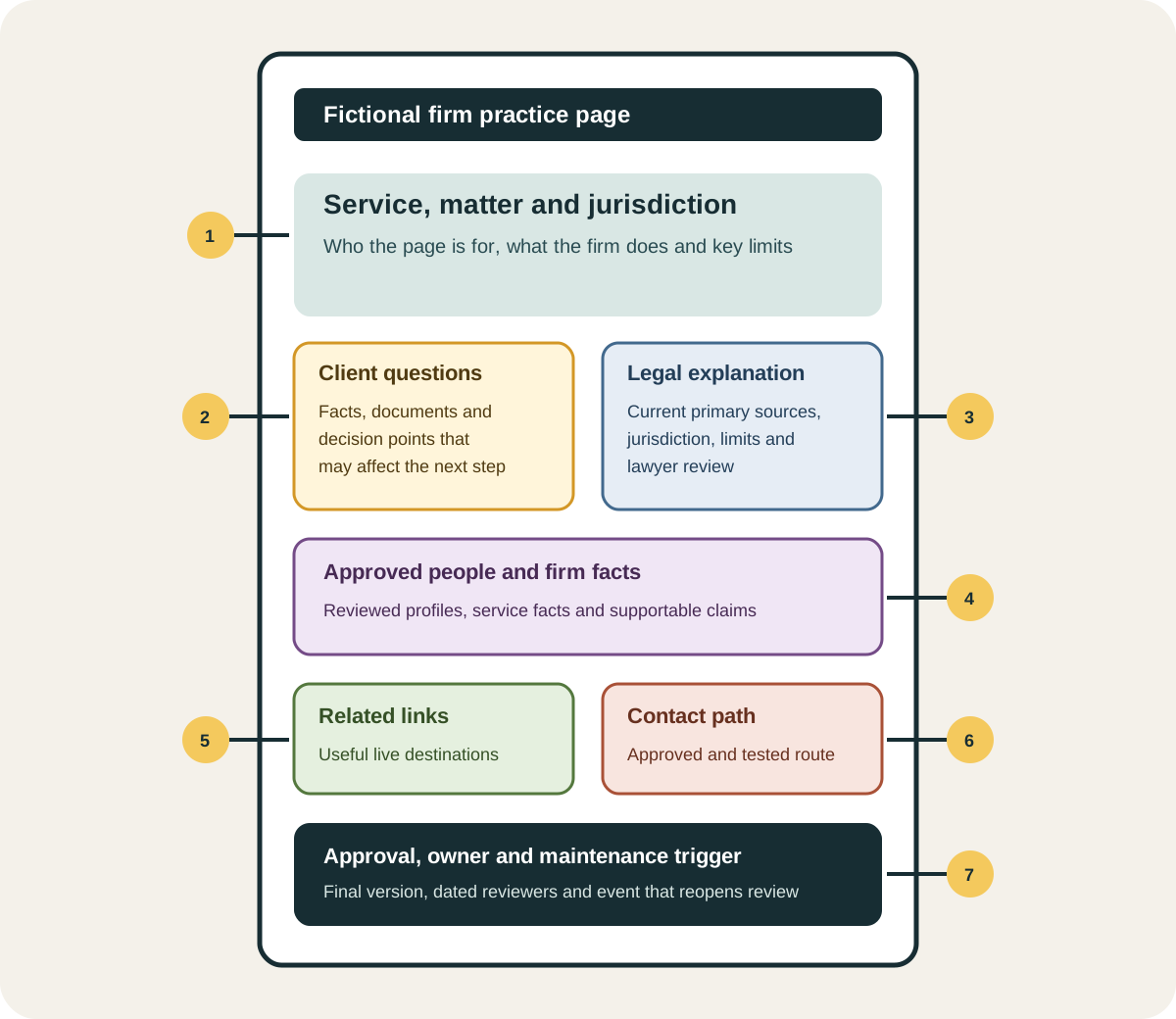
Use the labels as a handoff checklist:
- Confirm the title names the actual service and intended jurisdiction where needed.
- Check that the opening states fit and limitations without an outcome promise.
- Verify the client questions reflect real intake or practice knowledge.
- Trace the legal explanation to current primary sources.
- Confirm lawyer and firm facts against approved records.
- Test related links and the contact path.
- Record approval and the next maintenance trigger.
Run separate editorial, legal and technical gates
One review pass should not attempt to answer every question.
| Review gate | Accountable owner | Artifact or evidence | Hold condition | Maintenance trigger |
|---|---|---|---|---|
| Brief approval | Practice and marketing owners | Matter, reader, jurisdiction and page relationship | Service scope or audience is unclear | New service or strategy change |
| Source review | Researcher and responsible lawyer | Source register with checked dates and limits | Important legal statement lacks suitable authority | Law, rule or procedure changes |
| Firm-fact review | Firm owner for the fact | Approved fact register | Location, fee, credential or service claim is unconfirmed | Staff, office or policy changes |
| Editorial review | Editor | Structured draft, link map and resolved questions | Copy is generic, repetitive or outside the brief | Major content revision |
| Legal and claims review | Responsible lawyer | Dated approval of identified legal points and claims | Required reviewer has not approved | Source or claim changes |
| Intake review | Intake and privacy owners | Approved contact wording and synthetic test record | Destination, consent or handoff is unresolved | Form or intake-system change |
| Technical review | Publisher or developer | Rendered page, canonical, metadata, links, graphic and responsive checks | Build, link or accessibility check fails | Template or platform change |
| Live verification | Publisher | Public URL, sitemap, asset and response checks | Deployed page differs from approved version | Deployment or redirect change |
Editorial review should inspect clarity, duplication, structure and whether every section serves the reader task. Legal review should inspect substance, jurisdiction, limitations and marketing claims. Technical review should inspect the actual rendered page, not only a document draft.
For accessibility, check heading order, descriptive links, meaningful alternative text, keyboard access, table headers and small-screen table behavior. Useful graphics should add information instead of reproducing decorative text.
Publish with an owner and maintenance trigger
Approval is version-specific. Record the final destination, approved source file, reviewer, approval date and publication commit or change record. If production edits alter legal substance or a claim, reopen the appropriate review.
After publication, verify the live URL, canonical, robots treatment, sitemap entry, internal links, graphic, download and contact route. A successful build alone does not prove that the public page is correct.
Assign one page owner and a practical review trigger. Triggers can include a law or procedure change, a lawyer leaving, a service or office change, new intake instructions, a broken destination or a planned periodic review.
Download the law firm practice area page review worksheet. It is blank. It contains no firm findings, legal conclusions or completed approvals.
For help planning, writing and publishing a reviewed practice area page, contact Small World Marketing. Apply the same evidence and approval standards to our work.
Sources and limits
This guide relies on current primary documentation checked on November 4, 2026:
- Google Search Central guidance for helpful, reliable, people-first content;
- Google Search Central link best practices;
- Law Society of British Columbia, Chapter 4 marketing rules, used as one jurisdiction-specific example;
- Office of the Privacy Commissioner of Canada Privacy Guide for Businesses; and
- Office of the Privacy Commissioner of Canada safeguards guidance.
The responsible lawyer must review the page for the firm's jurisdiction, legal substance, services, facts and professional obligations. Privacy and security reviewers must assess the actual intake design and applicable law. This guide does not provide legal advice, report a market study, state search volumes or promise rankings, inquiries or results.