Useful blog topics come from the questions a firm is asked and the matters it accepts. Organize them by practice area, jurisdiction and client task so each article supports a clear service page.
A list of titles is not an editorial plan. Each topic needs an accountable reason to exist: a real reader task, confirmed service fit, suitable primary sources, a named legal reviewer, a useful next step and an owner who will maintain it.
Small World Marketing sells content strategy, writing and publication services to law firms. That is a commercial interest. This guide explains the controls we would expect in a useful topic system. It does not report keyword volumes, predict rankings or replace the responsible lawyer's review.
Start with matters the firm actually accepts
The first filter is service fit. A high-interest question is a poor topic when the firm does not handle the matter, cannot serve the reader's jurisdiction or has no approved intake route for it.
Begin with the current practice pages and intake categories. For each service, record:
- the matters the firm accepts, declines or refers;
- the jurisdiction and geographic limits;
- the types of readers the firm can assist;
- the questions intake staff hear repeatedly;
- the documents or facts a lawyer normally needs before giving advice;
- the urgent situations that require a direct contact route instead of a long article; and
- the service page, lawyer information and contact path that should follow the article.
The firm's approved scope is evidence. A competitor's topic list is not. Do not create a page about a procedure, remedy or case type merely because another site has one.
The practice area page review guide explains how to confirm scope, jurisdiction, sources, lawyer facts and contact instructions on the service page that an article supports.
Turn intake questions into defined reader tasks
An intake question is a starting point, not a publishable headline. Remove identifying details, combine recurring patterns and ask what the reader is trying to decide or prepare.
| Question source | What to record | Useful topic signal | Do not publish directly |
|---|---|---|---|
| Intake call or approved call notes | Anonymous question, matter category and next step | Repeated confusion before a consultation | Names, facts or quotations from a prospective client |
| Lawyer consultation pattern | Decision point, missing document or common misconception | A task the lawyer explains repeatedly | Privileged advice or facts from an identifiable matter |
| Existing service page | Unanswered subtask and intended next page | Supporting explanation that keeps the service page focused | A duplicate version of the same service pitch |
| Search Console page and query data | Landing page, query, date range and observed mismatch | A real query that the current page does not answer well | A claimed demand estimate or result forecast |
| Court, regulator or government update | Source, effective date, jurisdiction and affected service | A material change that readers need to understand | A summary published before legal review |
| Published firm resource | Broken link, stale date, changed process or missing example | A refresh or consolidation opportunity | A new article when repairing the existing page is clearer |
Keep the source record separate from the draft. The record should identify who supplied the question, whether it may be used, which details were removed and who confirmed that it reflects the firm's work.
Google recommends content created for an existing audience that helps people achieve their goal. It warns against producing many unrelated pages in the hope that some attract search visits. That makes an intake-led inventory more useful than a generic quota of weekly posts.
Define the article before assigning a title
Write one sentence for each of these fields:
- Reader: who is trying to complete the task?
- Situation: what has happened, without assuming facts that are not known?
- Task: what should the reader understand, compare, collect or decide?
- Boundary: which jurisdiction, service and date limit the explanation?
- Evidence: which primary sources and approved firm facts support it?
- Reviewer: which responsible lawyer will approve the legal substance and claims?
- Next step: which live service page, related resource or intake route helps next?
- Maintenance: what event should reopen the article for review?
If those fields cannot be completed, hold the topic. A clever title does not repair missing scope or evidence.
Use this practice-area topic bank as prompts, not preapproved copy
The examples below are question patterns. They are not findings about demand and they are not ready-made legal advice. A firm should remove topics outside its services, adapt the language to the intended jurisdiction and replace the evidence note with specific current sources.
| Practice area | Example client question | Reader task | Evidence and review needed |
|---|---|---|---|
| Family law | What should I bring to a first separation consultation? | Prepare documents and questions | Firm intake requirements and responsible lawyer review |
| Family law | Which family laws may apply to divorce, property and parenting issues? | Identify federal and provincial or territorial layers | Current legislation, official guidance and jurisdiction review |
| Family law | What information helps build a parenting plan? | Organize decisions about children | Current Justice Canada resources and lawyer review |
| Family law | What documents are used to discuss child or spousal support? | Prepare financial information | Current rules, forms, tables and firm process |
| Family law | When does a family issue need an urgent safety response? | Recognize the firm's emergency contact boundary | Approved safety wording, local resources and lawyer review |
| Family law | What is the difference between an agreement and a court order? | Understand the type of document involved | Jurisdiction-specific law and lawyer review |
| Personal injury | What should be documented after an incident? | Preserve a factual record | Jurisdiction, matter type, approved evidence guidance |
| Personal injury | Which deadlines might affect an injury claim? | Identify the need for prompt legal advice | Current statutes and rules, with no universal deadline claim |
| Personal injury | What records can help explain treatment and lost income? | Organize available documents | Firm process, privacy limits and lawyer review |
| Personal injury | How should a reader prepare for an insurance conversation? | Understand the firm's approved next step | Current insurer process and careful claims review |
| Personal injury | What changes when an incident involves a public body or workplace? | Identify a possible procedural difference | Current jurisdiction-specific authority |
| Personal injury | What can a first consultation cover without predicting a result? | Set accurate intake expectations | Approved firm scope and no outcome promise |
| Criminal defence | What happens after arrest or detention? | Find immediate, jurisdiction-specific help | Current law, official rights information and lawyer review |
| Criminal defence | What information should be ready for a bail consultation? | Prepare for urgent intake | Current procedure, firm intake and lawyer review |
| Criminal defence | What is a first appearance and what should a person confirm? | Understand the next procedural step | Current court information and jurisdiction review |
| Criminal defence | What is disclosure and how is it handled in the firm's process? | Understand a case-information stage | Current law and approved service process |
| Criminal defence | How can a charge affect work, travel or immigration status? | Identify connected advice needs | Cross-practice review and no generalized consequence claim |
| Criminal defence | When should a family member use the firm's urgent contact route? | Reach the correct intake path | Approved availability and contact instructions |
| Employment law | Is the workplace federally, provincially or territorially regulated? | Identify the correct legal framework | Current government jurisdiction guidance |
| Employment law | What records should an employee or employer keep after a termination? | Organize documents and dates | Applicable law, firm scope and privacy review |
| Employment law | Which questions belong under employment standards, human rights or a contract? | Identify the issue category | Current authorities and lawyer review |
| Employment law | How do leave, vacation or overtime questions depend on jurisdiction? | Find the correct official source | Current legislation and employment-status facts |
| Employment law | What should be reviewed before signing a workplace settlement? | Recognize the need for advice before agreement | Firm scope and lawyer-approved limitations |
| Employment law | What makes an independent-contractor question fact specific? | Collect relevant relationship facts | Current tests and lawyer review |
| Immigration | Where are the current application forms and instructions? | Use the official process source | Current IRCC forms and checked date |
| Immigration | What should a person record after receiving a request or deadline? | Preserve the notice and act promptly | Current program instructions and lawyer review |
| Immigration | How can a status change affect the next available option? | Identify the need for case-specific advice | Current legislation, program rules and facts |
| Immigration | What documents commonly need consistency across an application? | Prepare a document review | Program-specific checklist and firm process |
| Immigration | How should a refusal letter be prepared for legal review? | Organize the decision and record | Current procedure and lawyer review |
| Immigration | How can readers identify official forms and avoid imitation sites? | Verify the source of instructions | Current Canada.ca and IRCC guidance |
| Trademark law | What can a preliminary trademark search reveal and not reveal? | Understand the limits of an initial search | Current CIPO database guidance and agent or lawyer review |
| Trademark law | How are goods and services described in an application? | Prepare for classification and drafting | Current CIPO resources and professional review |
| Trademark law | What kinds of marks may face registrability questions? | Identify issues for advice | Current legislation, official guide and review |
| Trademark law | What is an examiner's report and what should an applicant preserve? | Organize a response record | Current CIPO procedure and deadline review |
| Trademark law | What happens when an application is advertised or opposed? | Understand the procedural stage | Current official process and professional review |
| Trademark law | What ownership, licence or use records should a business maintain? | Prepare an evidence inventory | Current law, agreements and professional review |
The six practice groups match existing Small World Marketing examples: family law marketing, personal injury law firm marketing, criminal defence marketing, employment law firm marketing, immigration law firm marketing and trademark law firm marketing. The examples do not imply that every firm offers every service.
Separate evergreen guidance from dated updates
Some questions remain useful while the answer changes. Label the page by maintenance need instead of pretending every article is evergreen.
| Content type | Suitable use | Required controls | Refresh trigger |
|---|---|---|---|
| Stable preparation guide | Documents, decision fields or consultation preparation | Service fit, approved process and periodic link check | Firm process or intake change |
| Legal explanation | A defined concept in one jurisdiction | Primary authority, responsible lawyer and version-specific approval | Law, case or regulator change |
| Procedure guide | Court, tribunal, registry or application step | Official instructions, checked date and limitation language | Form, fee, deadline or process change |
| News or decision note | A material new development relevant to current clients | Source document, publication date and clear scope | Appeal, amendment, implementation guidance or later decision |
| Firm update | New lawyer, office, service or event | Approved firm fact and accountable owner | The underlying fact changes |
| Search-led support article | A real observed query that does not fit an existing page | Search Console record, distinct task and link plan | Query pattern or destination changes |
Do not change an article's date to make it look current when the substance has not been reviewed. If a legal point may have changed, show the checked date and reopen the legal gate.
Give every topic an evidence and review route
A topic should move only when its next gate is clear.
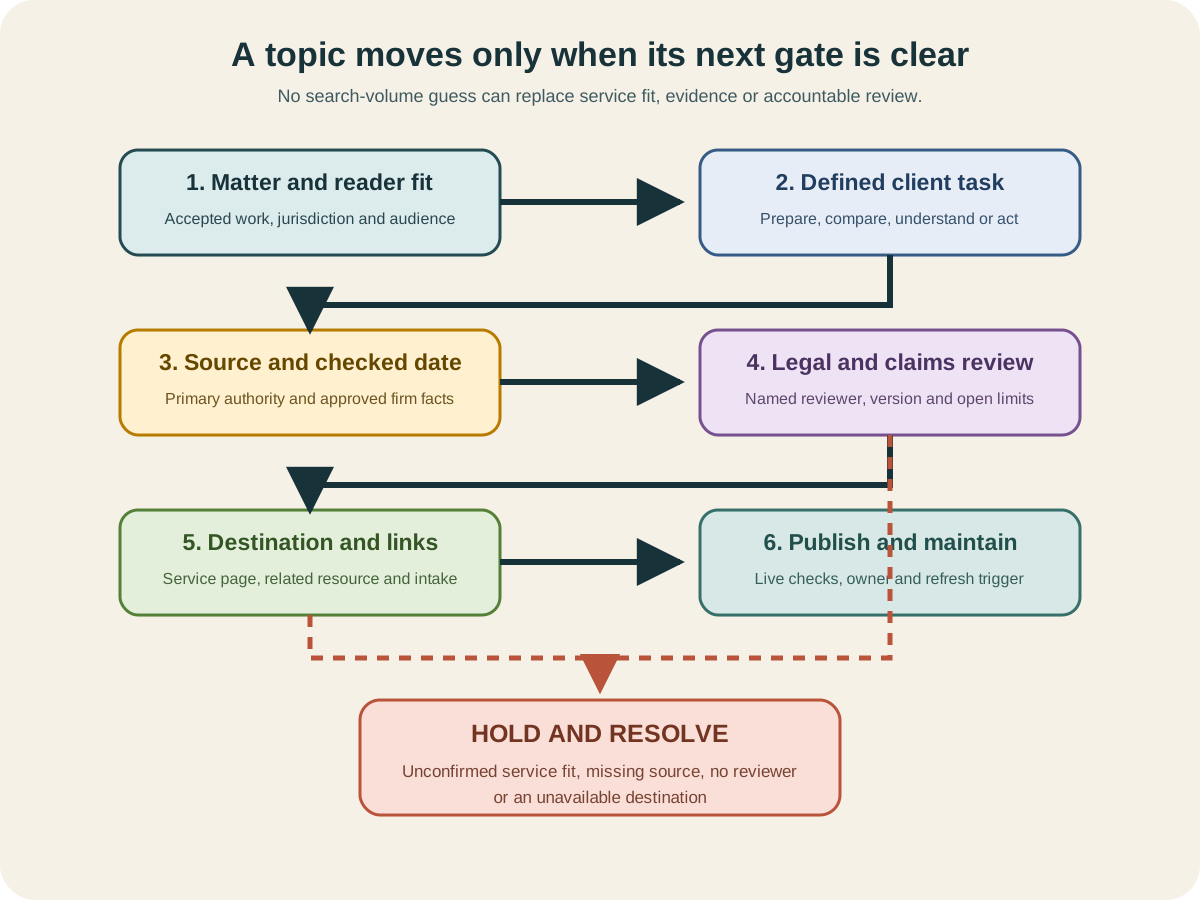
Use the matrix from left to right:
- Confirm the matter and reader fit the firm's accepted work.
- Choose the intended service page or operational destination.
- Classify the source as stable, changing or event-specific.
- Name the source owner and responsible legal reviewer.
- Decide whether the piece is a new article, a refresh, a section on an existing page or a hold.
- Define publication checks and the maintenance trigger.
The hold branch is part of the system. Use it when a service fact is unconfirmed, a primary source is missing, a lawyer has not approved the legal explanation or the intended contact route is not ready.
The Law Society of British Columbia's Chapter 4 is one jurisdiction-specific example of why the claims gate matters. It says lawyer marketing must not be false, inaccurate, unverifiable, reasonably capable of misleading the intended recipient or contrary to the public interest. It also identifies unjustified expectations about results as a problem. Firms in other jurisdictions need review against their own current rules.
Connect each article to a real next step
An article should not end in an unrelated sales pitch. The next step follows the reader task.
- A preparation guide may link to the matching service page and approved consultation instructions.
- A broad explainer may link to a narrower article only when that article answers the next question.
- A dated update should link to the current standing guidance, not become an isolated archive item.
- A topic outside the firm's service scope may link to an appropriate public resource or remain unpublished.
- An urgent question should use approved direct-contact wording rather than asking the reader to navigate several pages.
Use ordinary crawlable links and descriptive anchor text. Google recommends linking every important page from another page and writing concise anchor text that helps people understand the destination. There is no useful reason to repeat a keyword in every link.
Map the article to the law firm content marketing service, the relevant practice page and the firm's actual contact route before drafting. Test all three after publication.
Measure usefulness without turning correlation into a claim
Record the intended outcome before publication. Suitable observations can include:
- impressions and clicks for the article's intended task;
- which queries and pages are connected in Search Console;
- navigation from the article to a relevant service page;
- use of an approved contact route;
- intake staff reports that the article answers or fails to answer a recurring question; and
- broken links, stale sources or reviewer-requested corrections.
An article view is not a qualified inquiry. A page that appears before an inquiry did not necessarily cause it. Keep branded and non-branded observations separate where useful, and record the date range and known limits.
If several articles overlap, consolidate them or strengthen the primary page. Publishing another title is not the only response to an observed query.
Use a worksheet that records decisions, not guesses
Download the law firm blog topic planner. It includes fields for the reader task, practice, jurisdiction, matter fit, question source, primary authority, checked date, reviewer, destination, internal links, publication decision and maintenance trigger.
The worksheet is blank. It contains no keyword volumes, legal conclusions, completed approvals or client information. Use anonymous topic patterns and keep confidential intake records in the firm's approved systems.
Sources and limits
This guide relies on primary documentation checked on November 11, 2026:
- Google Search Central guidance for helpful, reliable, people-first content;
- Google Search Central link best practices;
- Law Society of British Columbia Chapter 4 marketing rules, used only as one jurisdiction-specific example;
- Justice Canada family law information;
- Justice Canada overview of civil and criminal cases;
- Government of Canada list of federally regulated industries and workplaces;
- IRCC application forms and instruction guides; and
- Canadian Intellectual Property Office trademarks guide.
Official information pages do not approve a firm's article. The responsible lawyer must review the service scope, jurisdiction, legal substance, examples, limitations, marketing claims and contact guidance. This guide does not provide legal advice, reproduce confidential intake information, report a search-demand study or promise rankings, inquiries or results.